Showing posts with label Mind. Show all posts

Friday, May 21, 2010

"Meeting the Shadow: The Hidden Power of the Dark Side of Human Nature" edited by Connie Zweig and Jeremiah Abrams

After another bout of writing, some to do with Psychology, I was reminded of an incredible book that I should share on here, about peeking into the Shadow. This is really mind cool stuff-- a collection of short essays on the 'Shadow'...not to be read front to back, but nibbled on.

If you're not familiar with the term, "Shadow," Psychologists Sigmund Freud and Carl Jung bandied about terms regarding what they thought made up a Personality, namely, what is the process of Human Personality Development. This is all very obscure stuff to measure, of course (being Psychology), but after 20-30 years of dealing with a vast array of Psychological traumatized patients, and finding patterns, some these two mavericks had a great base of experience to draw from. Even more fascinating, they both made detailed records of their dreams, and analysed the symbols therein (leading to some of Jung's most provocative work on Archetypes). What arose, in one form or another, was a theory of development whereby the Human Personality is said to split into the Persona, and the Shadow. Basically, the whole 'Self' (you and everything about your personality) is split into the Good part (the Persona) and the Bad part (the Shadow).

Before I get attacked for using such childish language here, the "Good" part is not necessarily good; its only good because Society says it's acceptable and polite. The Bad is not necessarily bad at all, except that Society says it's inappropriate or unsuitable for public display. (As you can imagine, this means Shadow and Persona traits likely vary from country to country, and change over time, as society's norms change).

Remember when you were in primary school, and a teacher told you not to speak out or make jokes in class. Maybe you liked to ask very interesting or unique questions in class, and the teacher told you to be a good boy/girl, and only ask 'good' questions. Maybe you told your parents you wanted to learn the electric guitar, and they said you couldn't because they didn't want you to hang out with a 'bad crowd.' When we are very young, we are free of hindrances, brashly expressing ourselves, like little Emperors and Empresses.

"I'm hungry!" "I'm bored!"  "I want candy!"  "I'm not sleepy, I wanna stay up!"

Society eventually nudges us in the "right" direction, by telling us what we should and shouldn't do. This is why we need a Shadow. We need a place to put all those 'bad' character traits.

In terms of Personality development, as soon as we learn certain things are 'bad' and certain things are 'good', we subconsciously remove certain elements of our personalities from 'public display.' That is, we take certain parts of our personality and put them into the 'Shadow.' All the things which society says are 'acceptable' become the Persona. The result? Most of us are civilized men and women, following the rules, waiting for the right traffic light to go, and waiting for the right signal to approach and talk to our fellow man, never acting on impulse, always subconsciously calculating to do the 'right' and most 'polite' thing. Subconscious is the key here. To stay sane, and stay congruently in Society, the Persona must act as if the Shadow doesn't exist.

As it turns out, if we are very 'good' people, much of our 'life energy' is trapped in the Shadow. We are essentially living half of our true personality, and putting half our personality, half our impulses and half our desires, in a prison of sorts.

Sometimes, in the midst of a trauma, a crisis, or an emotional breakdown, the Shadow will 'break out of Jail' and let itself be known. Also, if we ignore it long enough,  eventually it will burst onto the scene, with all its wild impulses and outrageous ideas. After all, if we follow the 'Persona' all our lives, and don't feel happy or fulfilled or loved, eventually the Shadow's nagging whispers will start to make sense! Perhaps not surprisingly, in addition to life energy, much creative energy is locked up in the shadow. After all, whats could be more boring, than a movie, TV show, or song spawned from dozens of intermingling 'acceptable' and Politically Correct traits and feelings.

'Meeting the Shadow' not only outlines much of Carl Jung's ideas (which did differ greatly from Freud, by the way) on the Shadow, it also outlines potential strategies for bringing the Shadow to the for (hence the title). The goal is not to become crazy. The goal is not to go on a wild killing spree. Locked up in the Shadow are very good traits, the problem is Society has given broad generalisations to young impressionable Children who then took it to the extreme.

"Don't Yell"
"Boys don't cry"
"Girls don't talk like that"
"Always wait your turn"
"Be nice to people older than you"

These may be good guidelines for young people, but as rules to live by they are ludicrous. Never Yell? Ever? Is it also a bad thing to get mad? Is it a Sin to ask for something, like food, or attention, or love? Also, if an older person is abusive to you (physically, emotionally, etc) should you let them??

As you can see, as we get older, we absolutely must examine the 'over-simplistic' beliefs  and rules we had as a child. If the Shadow goes ignored, it results in lifeless slugs, dead on the inside, from lack of expression, slaves to their childhood masters. Not only are they unattractive to the opposite sex, they are unattractive employees, and unattractive friends. Those who do not reconnect with the Shadow, ultimately become Zombies, constantly in fear of 'crossing the line' and occasionally snapping in a burst of 'Shadow' fury.

I know what you're thinking. Yes, sometimes these 'bursts' where the Shadow demands to be heard can be dangerous and shocking. It would not be surprising to hear that a normally quiet and subdued man woke up one day, mad at the world, mad that he's done everything 'right' and is still sad, lonely, and wretchedly poor, and suddenly gave into all of his Shadow instincts at once, possible attacking or hurting people in his apartment building or office.

Another fascinating consequence (according to Jung's work) of having an overly 'heavy' Shadow, is that we project those 'bad' traits onto other people. After all, if I'm such a good boy, then the only source of 'rude' and 'selfish' behavior in the world, must be other people, preferably people of my same gender, but from another country, or social class. It's incredibly common to hear ourselves or others make comments like "Everyone from [City X] is a jerk" or "I don't know, I just think people who [play badminton, drink espresso, write blogs] are the scum of the earth," and when we hear that, its the Persona bashing the Shadow. The Persona is saying, I don't like these traits so I've projected them onto people who play badminton, or work on Wall Street. Yes, this has dozens of implications for not only Racism, but also Wars. We have a situation in the US right now where Mexicans are being characterized by some as 'unfairly cheating' and 'trying to take our way of life'. Trying to build walls (or in Arizona's case, a fence ) to keep the Shadow away, is at once hilarious, and deeply sad.

If you can cut the Shadow down to size, and bring more Shadow traits to the fore, you can cut down on this insane Blogger bashing. Anyway, the goal here is not to go crazy and delve into the most bizarre impulses, but to get back that energy, that's locked up in the Shadow. The relaxed, cool, eccentric man understands and is curious about his dark side, and occasionally expresses it through art, or poetry, and is never afraid to stand up, and 'selfishly' ask the questions he's burning to have answered. Moreover, if his house is robbed, or his is physically threatened, he needs to channel his Shadow energy to protect them, not be the good boy.


A basic understanding of the Persona and Shadow complexes (that's what they are, just ideas, not actually real 'areas' of the brain, etc) helps guide us to understanding the Ego--how we can tame it, and how we can harness it. Perhaps I will write more about this in future.

Wednesday, March 24, 2010

Staying on the Path. "Mastery" by George Leonard

Mastery is a funny thing.. we usually use the word when we consider someone to do something effortlessly --like playing the Piano, speaking a foreign language--especially when someone is able to be creative and playful with a particular skill. We think, 'he's so comfortable, he's such a master in the kitchen, he was able to come up with his own recipe for this delicious Tomato Sauce!' And of course, we'd all love to get to that stage, in our jobs, in our hobbies, and in our relationships.

George Leonard started off in the US Army, becoming a 'master' of flying bombers/jets and became a teacher in that field. After the Second World War, he stumbled upon Aikido, and soon fell in love with the martial arts. He has long since achieved several levels of black belt and started his own Aikido academy. The path of Mastery he describes is based on his own endless journey towards 'Mastery' of Aikido. Towards, not to.

Is this book about Martial Arts, or landing Fighter Jets? Of course not. This book is for anyone that ever picked up a tennis racquet, tried to learn a new business, learn a language, monetize their hobby, or get serious about their fitness. Pretty much anything you do, can be taken to the level of 'zen-like' practice. This word practice is very important. We're not talking about 'practicing free throws' or 'practicing Calligraphy', but practice as in, 'he's been practicing Medicine for 20 years in that same small town.' The word, not surprisingly, conjures images of wise old masters from the Shinto age, in deep states meditation.

And why would you want to treat your Golf swing like an Ancient Monk would?

Because that's the only way you'll enjoy it. And that's when you'll really get good at it.

Leonard describes how most people pick up a new hobby or sport (eg. Rollerblading, Cross Country Running, etc) and how people find various ways to get frustrated/bored in the very early stages, and give up. Mastery should then be redefined not as 'being perfect at something', but 'staying on the path' not just for a while, not just for a few years, but for the rest of your life. Leonard himself can be considered an Aikido master, but he doesn't think so. He still sees ways to improve, ways to be more focused, ways to be more in the moment.

He mentions the tireless dedication of NBA legend Larry Bird in his own 'practicing.' Often showing up to the gym 2 hours before anyone else, not just practicing shooting, but pushing the limits of what would be possible, even practicing lobbing shots in from the 5th row. Countless excercises--dribbling, shooting, passing--thousands and thousands of shots that no NBA fan would ever see. What could possibly push an athlete to do this? Fame? Respect? Money? Not likely, fame and respect were already achieved in college. Money as a motivator probably would have put Larry Bird in Law School, not the basketball court. At any rate, he had that a couple years into his career, and still outworked everyone on the court late in his career.

The truth is simple: Larry Bird (and Jordan, and Magic Johnson, and Kareem) wasn't motivated by external things. He really loved to practice. His excellence on the court was just a consequence of his pure joy during practice time.

Our obsession with results is the number one thing ruining our pursuits, and standing in the way of Larry Bird-esque results. So where does it come from? Turn on a television and you'll get a hint: as Leonard describes, our modern consumerist culture, as portrayed on TV, is a series of... ahem... 30 second climaxes (whereby a product solves all your problems in a moment of pure ecstacy), interrupted by 30 minute stories, easily solved by happenstance or dumb luck. Life is so easy. The message: 'If you can't figure something out in 30 minutes, it's probably impossible. And not worth it anyway.'

If you hate to learn, try new things, make mistakes, you will drop out as soon as you possibly can, or keep going for a long time with mediocre results. Consider this book the guide to cultivating a love and joy of practice, and that is the true key to excellence.

Friday, February 19, 2010

"Synchronicity: An Acausal Connecting Principle" by Carl Jung

What is an amazing coincidence? Is it magic? Is it just impossible luck? Maybe its nothing more than a roll of the dice that the you wake up one day, and you have the flu. As a result you don't go into work, and a few hours later there's a huge snowstorm, and the afternoon rush hour roads are jammed and your colleagues don't get home until 10PM that night. In such a case, you feel blessed to have gotten the flu. But was it just a coincidence, or, was it written, somehow?

One could theorize the weather and your sickness were related. But sometimes, just sometimes, there cannot be any connection whatsoever, and the only two 'explanations' are that you've witnessed a) an amazing coincidence or b) a miracle.


I've wanted to read this book for a number of years; I've been a huge fan of Jung's work since I started reading his amazing insights into personality development (Id, ego, projection, etc). Synchronicity goes beyond those 'theories' of psychology and borders on the paranormal.

Synchronicity, I assumed, was his theory to explain the occurrence of unbelievable 'magical' circumstances, and perhaps, what they can tell us about ourselves. Be warned: although this is only a 120 pager, this was academic piece from a brilliant man, written in 1960. In other words, put the coffee on.

Having read it, I can't believe where Jung went with this idea. Having first introduced the notion of causality and 'connected events' he posits that in such a complex world, it would be easier to start by looking for events that are unique-- they are indeed rare. Connected events are everywhere. He delves into rigorous statistical analysis of card games and dice games, and concludes that ESP may be possible, as well as 'willed outcomes' (Think, The Secret).

This is where Jung gets going. He puts away the calculator for a second and turns to.... Chinese Philosophy?

Having first pondered the possibility of ESP/Psychics/psycho-kinetics, he then discusses several ancient systems of divination, preferring the Chinese (Like the 'Yi Ching') for their holistic approach (again, almost everything is connected). He goes into a very spaced out and esoteric trip consisting of galactic forces (in attempt to prove or disprove Easter and Western Astrological forecasts) and Greek Gods--seriously--knowing that all these things are man's 'creation', the common link is, Archetypes?

Archetypes are an idea of patterns, figures and characters that are common throughout the world's cultures and eras. These seem to be models for possible personalities and relationships which are so universal as to be, perhaps, wired in our DNA to understand (eg. The Hero, the Trickster, the Nurturing Mother--these are ingrained ideas which Jung believes compose our dreams).

This is really an amazing book whereupon, Jung attempts to sit down and prove the power of our minds to either predict the future or create it. I won't spoil the end, because I won't do it justice, obviously, but I'll share an anecdote, which occurred just after I finished reading the book.

It just so happened that during my Think Week, I'd finished a book called 'The Ascent of Money"the day before. Now, there's a part in that book which mentions Mary Poppins: apparently, there's a scene in Mary Poppins where everyone wants to take their money out of the bank at the same time, causing a run on the bank's money. Why do I mention it? Because just before going to sleep that night, and I was watching some TV (keep in mind, this is China, most of the Channels are Chinese talk shows and dramas). I stopped on what looked like a very old movie, with some old-looking white people. It was Mary Poppins.

Why is that weird?

Well first of all its about 50 years old. Secondly, its geared towards a North American audience, making it less liklely to have any appeal whatsoever in China in 2010. The fact that I remembered 'Oh yeah, I was just reading about this yesterday' was amazing. And I'd actually bought that book 'The Ascent of Money' about 6 months prior and never got around to reading it until then. It's amazing that I just so happened to get the book, and then let it sit on my coffee table for half a year before, in the right hotel, on the right week, watching the right channel at the right time, Mary Poppins shows up. And it would have been completely meaningless unless I'd read Ascent of Money they day before, instead of the day after.
You're right, I'm probably just grasping at straws there. Or maybe Synchronicity is just a matter of paying attention to the millions of coincidences and miracles that happen every single day.

Thursday, February 18, 2010

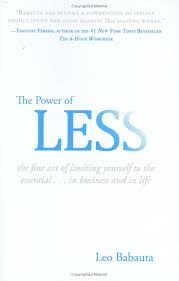
"The Power of Less" by Leo Babauta


I'd already been interested in the a more simplified Zen lifestyle (I've been meditating daily for a couple years now) and picked up this book because the title was so representative of my direction recently: less stress, less hassle, stop messing around and focus on the things and people that are really important to me.

This book is not just a 'guide' for doing less; it seeks to bust what I call the Multitasking Myth: that is, it emphasizes that by doing 14 things at once (MSN, Emails, Music, Twitter, Sending Text messages, Eating...etc) you're actually way less efficient. You're way more stimulated but way less productive.

(Note: there has actually been a bit of talk on 'Multitasking' recently on the web with the recent launch of the Apple iPad, which, unlike a real computer, is generally designed to run just one program at the same time. Techies screeched, "How can you get anything done without Multitasking?"... Ironically, it might be a great built in 'feature')

In this sense, at its core, the message is to 'unitask'. Focus on the task at hand, and finish it. In the same vein as Tim Ferris (http://www.fourhourworkweek.com/blog), Babauta is a big fan of batch processing things. Everything from Email to Errands, Bill Paying etc. And it struck me that its actually a very popular idea: just ask Henry Ford.

We've known the power of specialization of labour for so long, so... why are we so hung up on the idea (rather, the myth) of doing a bunch of different things at once? The truth is, to really hit your productivity groove, you gotta turn off the music, get off Facebook, and focus. The productivitity gains are amazing. I know, I know, the great thing about Multitasking is the flexibility, and the time-saving that comes from driving while you play with the your Blackberry, yada yada yada. Come on, what kind of brilliant writing have you done halfway through a Big Mac? Be honest.

Ok so that was just one element of the book, but I think it exemplifies what we're trying to do here, 'Power of Less' doesn't mean you're doing less, you'll actually do a ton of things, the point is less distraction and less wasted energy on things that, frankly, don't really mean much in the long run.

A big section of the book, Babauta talks about nailing 6 month to multiyear goals by breaking them down and, again, focusing on just a few goals concurrently (you could do just 1, ideally, but there are often time gaps between certain objectives, and we don't want to waste that time idly.)

If you find yourself getting sidetracked easily at work, (it's normal, we all do) definitely check this book out (as well as the aforementioned Tim Ferris classic, 4 hour Work week).

Follow this author on Twitter@zen_habits