Showing posts with label Money. Show all posts

Thursday, June 17, 2010

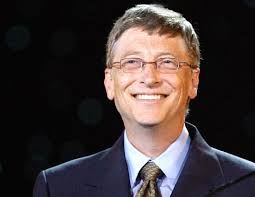
"Showing Up for Life: Thoughts on the Gifts of a Lifetime" by Bill Gates Sr.

"Eighty Percent of Success is Showing up."
Woody Allen, Comedian, Writer, Director, Oscar Winner

This is going to be a quick review, because it really was a quick read, but packed with great insights. I decided to grab this book a while ago after seeing a terrific interview with Bill Gates (Junior) and his dad (Senior) on Charlie Rose last year. Around the time everyone was raving about Outliers (Malcolm Gladwell's latest in a string of Bestsellers) here was the perfect example to prove Gladwell's point. 

Gladwell told the story of Bill Gates' life in great detail, outlining just how very impossibly lucky this kid was. But not only did he go to the right schools and live in the right town, he also had the right parents. And I think it's worth exploring how someone who works incredibly hard, and has made a lots of right moves, got a lot of that from his parents.

"Showing Up for Life" is not a Biography at all. It reads more like a letter from Senior to his family: each of his children, and his two wives (sadly, both were taken by terminal illnesses). Bill's maternal mother Mary, contributed a great deal to Bill's incredibly competitive nature. Early on, the Gates family, along with five other families, would head to wilderness for camping trips. Because they pooled their resources together, they were able to secure a cabin on the lake, where everyone could play games, and hold competitions of all sorts. Competition drove almost every aspect of life, whether they were playing capture the flag at Camp Cheerio, or playing a game of cards to see who got to skip out on washing dishes after supper. Mary had a knack for bringing fun to whatever they were doing.

That's a big deal. We sometimes think of these incredibly successful Entrepreneurs and think only in terms of dollar signs. We forget that this was the funnest thing in the world for them. In the Early Microsoft days, coding MS DOS for 12 hrs straight, then grabbing some pizza with your friends before going right back to the office again was really fun. Hey, they were geeks.

Also, to Gladwell's point, the charitable work that Bill and Melinda Gates are now doing did not start with Bill Jr. Some people, myself included, assumed he was an egomaniac, or was doing it because he felt guilty about his dominance in the PC market. Some even believe he just wants a Nobel Peace prize. But those people can't fully understand Bill Gates Jr, unless they first understand the man he strives to be: Senior had been involved with charities long before Bill Gates ever met MS co-Founder Paul Allen. In fact, Mary often asked her young children how much of their allowance they planned to give to charity.  

I thought it was amazing that Mary actually knew the CEO of IBM in the mid-80's, through their joint work with United Way. When he first heard about a little company in Seattle called Microsoft, he remarked, "Oh, that's Mary Gates' boy." And when Bill married Melinda in 1994 (up to that point, she was a product manager at Microsoft) her 'new job' became working on the charitable foundation full time.

And the idea of giving everything away goes a lot farther back than Bill Gates Sr. This would not be the first time Bill Gates was compared to John D. Rockefeller. Rockefeller was the greatest Oil tycoon there ever was, getting in at the turn of the 20th century, and ultimately becoming one of the greatest Philanthropists there ever was too. His legacy, passed down from generation to generation, is everywhere, from Malaria research to working on AIDS treatment, and helping famers in third world countries grow more bountiful crops. Everywhere Bill went, he saw the Rockefeller name. 

I don't want this to turn into a story about Bill Gates, because it's not. All the children are incredibly successful, which is kind of staggering. Bill Senior and Mary, and the way they chose to expose their children to new ideas, and new experiences, are the real story. And though Bill Senior, a lawyer by trade, was always finically well-off, they never seemed to let it go to their heads. In fact, there isn't a trace of ego anywhere with any of these guys

I found something striking with Bill Senior: being Christians and very rich, you would think they were fighting new tax bills left and right, as many talking heads on Network TV do. But if anything the Gates family is fighting for more taxes, every chance they get. Bill Senior actually got his start, when he returned from World War 2. The American recovery plan contained something called the GI Bill, which promised to pay for all those who served in WW2 to go to College. It was thought to be costly and extravagant at the time, but it worked: filling the offices and companies with young bright minds which would put America on a path to unprecedented growth. The Marshall plan was also widely criticized; the plan would put money forward to help America's allies recover from the ravages of War, but contributed to a sense of community and stability around the world.

These are two big pieces of legislation Senior picked out to demonstrate his inspiration for 'giving back.' And that's basically what a tax is: giving back to those who paid for the schools, the roads, the police departments that created the society in which you could, say, start a tech company. 

When I said I don't detect a hint of Ego in these guys, its more like, the Ego has grown. Sometimes we say 'WE' to mean our family, or our favorite team, or our city, or even our country (like in the World Cup). But what happens when it grows beyond that to mean the whole world? You feel pain when people on the other side of the world are hurting. Maybe that's why giving away 20 billion dollars, isn't just a 'nice thing to do' for these guys; but rather, it looks like so much fun.

"Dad, the next time someone asks if you're the real Bill Gates, I hope you say 'Yes.' I hope you tell them you're all the things the other one strives to be" 
Bill Gates Jr. Philanthropist, Technokid


Monday, May 31, 2010

"Good to Great" by Jim Collins

This book came out almost 10 years ago, but within its pages, are some of the most thought provoking results on Business Excellence. Actually, Excellence in general. The great thing about studying Public Companies is that we can study their freely available numbers, we can break down their acceleration of growth, and we can talk to their bosses and innovators.

And that's exactly what Jim Collins and his team of researchers did. They found a handful of companies that had huge sustained growth for 15 years and asked "What are they doing? How did they get here? Why are they so rare?"

What they found were a string of totally non-MBA answers. A few simple concepts and only 10 or 20 leaders in the country could hold themselves to. Wow.

First, the leaders: we know that leaders in business can be very loud, very cool, very power hungry and egotistic.But these types of characters were nowhere to be found in the study. What did the leaders of these great companies (like Nucor, Gillette, Wells Fargo) have in common, when it came to leadership?

Diligence, and Modesty. That's it.

If you can find a guy or girl who will work all day and all night, and will do whatever it takes to rigorously do the homework (on the competition, on new technology, when it comes to hiring, when it comes to expansion), who is modest to a fault, that's your future CEO.

And they discovered something remarkable about their compensation too: it doesn't make a difference.
All the nonsense and backdoor deals going on on Wall Street, and here's a group of the best companies in the last 15 years, according to Wall Street, and the compensation was not a motivating factor, and did not move the stock price up or down. So what was it then?

These old fashioned, hard working, modest guys just wanted their company (not themselves) to grow and be great. Part of that modesty the leaders were not going for glory but diligently, and rigorously, doing the hard things to promote the company, the group, the collective. And here's a crazy thought: if you really want your company to be great, you'll set it up so that it will continue to be great, even after you retire! How many retired CEO's do you know that lose sleep thinking about their old company?How many companies have you worked for, that you've worried about, long after you'd already left the job? That's real passion, loyalty, and care for the company. And it's rare.

There's another theme that really hit home for me, on a professional level and a personal level. They call it the Hedgehog concept based on an old parable of the Hedgehog: 


In the woods, the Fox is always trying to eat the Hedgehog, but never succeeds. He tries various tricks, pouncing in the day, pouncing at night, being slow, being fast, luring the Hedgehog, or a surprise attack, but he just fails and fails and fails. The Hedgehog, with none of the speed, agility, or aggression of the Fox, survives with one simple defense. Whenever it sees the Fox coming, it just rolls up into a ball with those spikes out. The Fox can do nothing when the spikes are out, so it eventually gives up and wanders off. The Fox goes hungry and the Hedgehog thrives.

How could such an weird looking creature be the basis for business and personal excellence? By sticking to one thing. Basically, the Fox can be compared to a company with tons of great technology, a bunch of different projects, and lots of resources. By bouncing around to different things, it never really focuses its energy on one thing. And why does that matter? Because it never gets to be the best in the world at one thing that way. And so you never hear about them.

As people, we can consider the Hedgehog an inspirational figure of sorts: it is born with this one talent, or trick. It exploits that talent every single day, and as a result it thrives. It doesn't aspire to be like the Fox in speed and agility, and even grace. It just plods along, and slowly but surely, becomes great at being...a Hedgehog. Think of a Comedian that works on this one set of jokes, for 15 years. For 15 years you never hear about the guy, and then suddenly, BOOM, he's everywhere. You start seeing clips on Youtube, you hear he has a new TV show and movie deal in the works, and your friend think he's the funniest thing on Earth. Thats how it happens. Not overnight, but a long, gradual, almost mundane process, of sticking to one great thing.

Back to business, we found that this is one of the hardest things for great companies to do: say no to trendy, cool, hot new projects that threaten to pull the company far away from their core excellence.
For example, in the book, the American Pharmacy Wal-Greens decided they wanted to be the most convenient pharmacy in the country. That was it. Once they had that idea, all decisions were easy. It meant doing some crazy things, (like closing a store, only to reopen a store a block away with better access from the main traffic routes, etc) but it got them all the answers. If you can prioritize, you can answer any question. And you can only prioritize if you have rigor and discipline.

The first two factors of the Hedgehog concept are Passion and 'Best in the World Focus.' The third and final factor is, at last, about money. After all, I didn't say these companies were the coolest in the US (a steel company and a drug company?), they were being highlighted because of their consistently excellent performance on the stock market.

The final factor was choosing a metric that defined how they measured excellence, and zeroing in on that target. These guys could aim to maximize profit per store, profit per employee, profit per country, profit per customer visit, anything they wanted. And each one had its own implications for future plans. The bottom line is this, the third factor is the way the company measures how well people are doing their jobs. Walgreens wanted to maximize profit per customer visit. That meant every time someone walked in the door, all the advertisers had done their jobs. Now it was time to see just how great the experience was to be in a Walgreens store. If it was great, profit would trend up. If it was confusing, noisy, over crowded, empty shelves, rude staff, the profit would trend down. It's that simple. By zeroing in on this one metric, Walgreens beat the market by a mile, year after year after year.

There's a ton in here, that I just couldn't get to. If you're into it, go pick it up, its a great read, lots of amazing anecdotes in here. Yes its a business book, and yes I've got some terrific ideas for my own job, but you can get a tremendous amount of personal insight as well. Here's food for thought : what one thing can I do, day in, day out, and eventually be the best in the world at?

Saturday, February 27, 2010

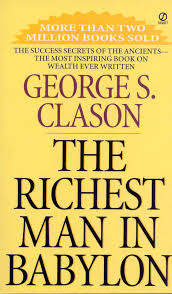
“The Richest Man in Bablyon” by George S. Clason

So I have to preface this review by saying,

a) This book was written in the 1920's.
b) This is a book about personal finance and budgeting.
c) I absolutely love this book and had so much fun reading it, I went back three more times!

Ok, let me explain: I actually bought "The Richest Man in Babylon" in Audiobook form about a year ago. There was a time when I would incorporate Audiobooks into my morning routine (multitasking), but now prefer the selection of Amazon.ca hardcovers and convenient delivery. If you want to pick this up on Audible.com, or download the Audiobook from iTunes, it is an absolute treat. If you get the actual book, it's pure genius and full of charm, but you won't get the great voice acting.

I know. Voice acting? Here's how it works: Clason was a businessman and early 'motivational' guru and would travel around the US distributing pamphlets that would show people how to save money, and build wealth. He didn't just say, 'Do this, do that', though; instead, he created parables set in Ancient Babylon, which would be more engaging and enjoyable to read than the driest subject on Earth...personal finance and budgeting.

So now you can imagine why I had so much fun 'listening' to this book. Set in Ancient Babylon, it tells tales of common men getting together to discuss how they can emulate the local hero, The Richest Man in Babylon (who himself, was a self-made man). The whole thing, as a parable, is one huge metaphor. First you fall in love with the story, then you feverishly jot down notes as you realize just how brilliant this is. The Babylon setting simplifies the whole thing into great archtypes, not overly confusing 401k, IRA, gibberish (which by the way aren't strategies at all, they're just tools).

As the richest man in Babylon relates in this book, even he can't afford to satisfy all his desires, and his stomach cannot fit all the food he might desire to eat each night. Even he is limited by the time on this earth, so he spends his time carefully (budgets his time?). Even he, with all his endless wealth, has a budget. And that budget works for him to make sure each meal is delicious, each hour is spent thoughtfully and enjoyably, and each dollar is spent usefully and intelligently. And here's the kicker: when he eats, he does not mourn that which had no space to eat. He is content with his choices.

Ok. So, so far, absolute gibberish and fluff, right? First we have to get past this idea that you have a money problem. You don't. If you made a million dollars a year, your bad habits would scale and you'd be just like those guys who win the lottery and squander it in 6 months.

The truth is, the fallacy of 'a few more bucks' is so ingrained in our mentalities, that we put off thinking about this stuff until we have more money. When that happens, we spend it. Look, it's pretty simple. In the West, we're just coming out of a huge recession, and yet the Stock Market seems to be ticking along just fine. What does that tell us? That people are still clinging to their credit cards. If you don't have a problem with credit cards/loans, you're the exception, not the rule.

What Clayton does with this book is demonstrate how the very poorest of tramps can start building wealth right now. Today. Is it simple? Sure. Can anyone do it? Yeah. If you have discipline, you can start paying down all your debts and building your own empire.

I'm gonna try not to plagiarize the book by reciting its laws. Go get it. I can, however, give you my own story. After reading this book, I jumped into Excel and starting doing the calculations on the elements it teaches you to focus on:

1) Pay down your debt
2) Contain your monthly expenses
3) Invest in something that will grow

What's hard about this? The initial 'woe is me' complaint that most people have stops them at step one. People also have this annoying fear of money: they'd rather not know how much credit card debt they have. I check every week, to make sure that number is going down.

Lastly I want to say this: if you take one thing away from this book, its that your salary doesn't matter as long as you have discipline; with discipline, you can eliminate your debt and be on the road to prosperity, health and ultimate happiness. Without discipline, you can be Nicholas Cage. Take your pick.

Wednesday, February 24, 2010

"The Ascent of Money: A Financial History of the World" by Niall Ferguson


So go back about 6 months, and I get a call from my parents, back in Canada. Who's going where, how's the garden, what's the next trip they're planning. And they mentioned to me they were watching this really interesting documentary on PBS called 'The Ascent of Money' and it was right up my alley. A couple weeks later, I was in a bookstore in Shanghai and saw it, so I picked it up. While I slogged through The Count of Monte Cristo, this huge book sat on my coffee table for months and months.

Having graduated in Economics, there were bound to be some nuggets in there that caught my eye. I wasn't really stoked for a review of my college textbooks though. Luckily, most of this book is great read because of the story, not the financial meandering (sparse, I promise). The context of what was going on, say, when the first banks started cropping up in Italy is what makes it so fascinating. And what a marvelous story it is: man's quest for riches, dating back to the Babylonians. So allow me to rephrase, this is an Economics book, that is more Archeology and History than x/y graphs and Interest rates.

The Ascent of Money track developments of money, from sheckles to gold pieces, and eventually paper and later online banking in context. A brilliant ride, he shows how , effectively the great wars, won and lost, had a few rich men pulling the strings (or at least betting on the outcome!). The section on the Rothschild family is awesome.

In as pleasant language as humanly possible, he outlines the development of the stock market, what the heck are bonds, why we need to know this stuff , and perhaps more interestingly, the families and empires that were built with the knowledge and understanding of their wallets, and just what incredible power they had.

He outlines the earliest developments of insuarance companies and how similar they are to the modern health care crisis of today (Britain, US, Japan, for example). And you can actually see right where everything broke down, where greed started to be institutionalized.

Obviously I loved it. The whopping Financial history of the world, leading up tot he Enron disaster, Long Term Capital Management, and the Subprime lending crisis (which, everyone hears about, but few actually really understand).

Not surprisingly, he dedicates a full chapter to the resurgence of China. Ferguson coins the symbiotic relationship with America "Chimerica": China lends money to the US, the US uses that money to buy from China (plus interest payments). It's lovely.

What I like the most about this kind of book, is that it does its best to hide the real nitty gritty financial (read: dull) minutiae, but gives you enough so you can follow along in what is really an amazing story.

If this subject is completely foreign to you, it should be a delightful (and enlightening) book. And yeah, I guarantee that after reading it, you will feel like the smartest person in the room. For a few days, anyway. ;)


Follow this author on Twitter@nfergus

Sunday, February 21, 2010

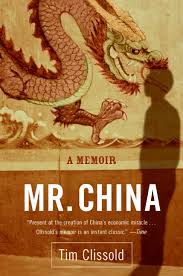
"Mr. China: A Memoir" by Tim Clissold


This one was reccomended to me by a fellow expat colleague back in 2008; finally got around to it, and it's a real gem. Before I go on about how the difference between East and West can cause problems, confusion, misunderstanding, (as well as wonder, fascination and reflection) I'll come right out and say it now:is a cliché. I know. But it is critical to understanding why certain things happen.

Put it this way, were it not for 'misunderstandings' Tim Clissold would be at the helm of a massive empire in China right now, and this book wouldn't exist. Everything they'd dreamed of and planned bumped up against this pervasive, ancient, unshakeable culture. This book is about their attempt to go ahead with their plans and how it all turns out.

This story is about a foreigner, who, like hundreds of thousands who followed him, had a fascination for the exotic, mysterious, richness of Chinese culture, and did everything he could to get 'over there.'

What usually starts off as flirting (traveling around for a week or two, hitting the Great Wall, picking up a book on learning/writing Chinese) turns to full on dating (move to China, get a cool job) and aspirations for a shared future (confidence in culturally and linguistically maneuvering throughout the cities and countysides, with the intent to settle down for good).

Our hero, Tim Clissold, is relentless in his desire to get into China and do something huge. He explains how he got a few lucky breaks, but did what it took to get money ( and lots of it) into China long before anyone on CNN was talking about it. He got in early, which meant, as a trailblazer, he had to be the real liason between East and West. We get firsthand insights on the big bosses in the developing Chinese economy. Just fascinating stuff.

The book turns into a series of Anecdotes about ways in which he dealt with 'the Chinese mind' by way of a handful of clever, tough, and sneaky Factory Managers, as well as navigating the Chinese political structure to not get fleeced in the Middle Kingdom.

I'll admit, the symbolism on the front cover (with a classic Chinese dragon 'biting' a mans head) is a little ominous. "Did he lose his shirt?" "Did he turn to bribes/backdoor deals?" It turns out that neither of these were really true. But his team of investors didn't 'take over' China at all. Not by a long shot.

What you will absolutely adore about this book, besides Tim's astute insight into not only the language and culture "challenges" but his 'case studies' are priceless. Somewhat unbelievable, almost always hilarious, he goes down the list of amazing stories of his mixed bag of Chinese investments. In many cases, the way his Chinese partners attempted to 'get the best of him' was very clever, and the followup is even better.

Come to think of it, the Dragon symbolism is befitting: by the end of it, the dragon doesn't bite his head clean off, it just takes a chunk out of his ego. I think they call that wisdom.

Saturday, February 20, 2010

Think Week

If you haven't heard of Bill Gates' Biannual Think Weeks, this is going to sound pretty crazy: he actually takes off, unplugs, and hides in a cottage twice a year to read books.

I know what you're thinking "Read books? That's so...old fashioned."

Yeah, he's done it for years (well, since he was able to afford a cottage in the hills). It used to be that he would read lots of weird books (really geeky stuff) on Computer Programming, and Financial Instruments, and Business Models, etc. These days, he reads an insane amount of stuff that all comes internally from Microsoft.

Managers at the software giant have 'homework' to hand in to Gates, who spends a week in silence, sipping Orange soda and making notes.

To me, the idea of this guy, worth about 60 billion, trudging up to some remote cottage to 'mark papers' from his employees of 'average intelligence' is just hilarious, and at the same time, inspiring. Even now, he still feels he has a tremendous amount to learn and still strives to be the smartest guy in the room.

So alas, there I was, pondering what to do with my Chinese New Year 'holiday.' I could go to Thailand or Japan, or Sanya, etc. All places which would be expensive/packed for the holiday, and I wouldn't be able to check emails if I was having too much fun, etc. Then it dawned on me... where can I go, where I'll have peace and quiet, and can actually do something productive, ala Gates?

If I stay at the apartment, its way too noisy, and I'll get sidetracked with Internet, Movies, Friends etc.

I actually found a middle ground: I got a hotelroom on the outskirts of Shanghai. A nice one, with internet on the first floor, and room service, out in the far west (near the airport). Minimal disruption, minimal fireworks (99% of the time), and I took a bunch of books.

And you know what? I can probably get away with doing it twice a year. Like I said, I can check emails daily, in the morning, survive off room service, and the amount of time I have devoted to just reading great books (preferably about your line of work, keeping up with the very latest trends in your job, or big picture stuff, like Gates) can be of huge benefit to your company.

One thing I will say, the amount of 'Wow' great ideas I've gotten from this week is astounding. That's how the brain words, you fill it up with 'information' and then it digests it over the course of a few days. It'll rattle around up there, and suddenly BAM, you get the answer to something that was puzzling you (about business strategy, about time management, or about how to get financing on the next big project).

Think about it... you could worse than emulating one of the richest (and smartest) guys alive.

Thursday, February 18, 2010

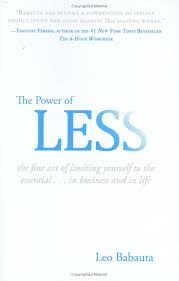
"The Power of Less" by Leo Babauta


I'd already been interested in the a more simplified Zen lifestyle (I've been meditating daily for a couple years now) and picked up this book because the title was so representative of my direction recently: less stress, less hassle, stop messing around and focus on the things and people that are really important to me.

This book is not just a 'guide' for doing less; it seeks to bust what I call the Multitasking Myth: that is, it emphasizes that by doing 14 things at once (MSN, Emails, Music, Twitter, Sending Text messages, Eating...etc) you're actually way less efficient. You're way more stimulated but way less productive.

(Note: there has actually been a bit of talk on 'Multitasking' recently on the web with the recent launch of the Apple iPad, which, unlike a real computer, is generally designed to run just one program at the same time. Techies screeched, "How can you get anything done without Multitasking?"... Ironically, it might be a great built in 'feature')

In this sense, at its core, the message is to 'unitask'. Focus on the task at hand, and finish it. In the same vein as Tim Ferris (http://www.fourhourworkweek.com/blog), Babauta is a big fan of batch processing things. Everything from Email to Errands, Bill Paying etc. And it struck me that its actually a very popular idea: just ask Henry Ford.

We've known the power of specialization of labour for so long, so... why are we so hung up on the idea (rather, the myth) of doing a bunch of different things at once? The truth is, to really hit your productivity groove, you gotta turn off the music, get off Facebook, and focus. The productivitity gains are amazing. I know, I know, the great thing about Multitasking is the flexibility, and the time-saving that comes from driving while you play with the your Blackberry, yada yada yada. Come on, what kind of brilliant writing have you done halfway through a Big Mac? Be honest.

Ok so that was just one element of the book, but I think it exemplifies what we're trying to do here, 'Power of Less' doesn't mean you're doing less, you'll actually do a ton of things, the point is less distraction and less wasted energy on things that, frankly, don't really mean much in the long run.

A big section of the book, Babauta talks about nailing 6 month to multiyear goals by breaking them down and, again, focusing on just a few goals concurrently (you could do just 1, ideally, but there are often time gaps between certain objectives, and we don't want to waste that time idly.)

If you find yourself getting sidetracked easily at work, (it's normal, we all do) definitely check this book out (as well as the aforementioned Tim Ferris classic, 4 hour Work week).

Follow this author on Twitter@zen_habits

Node Zero: "Love is the Killer App" by Tim Sanders


For my first review, I want to go back to the first book that sparked me to get into business. It was early 2000's, and I was working like a dog. At a factory. While I figured out what I was going to do with my life. Everyday after work, I'd get home and eat in front of the TV. Usually around 3 or 4 in the afternoon, there would be some 'Biography' or 'Inside the Actor's Studio' on, and I was always really into those, hearing about brilliant people, and their humble beginnings.

It was around this time that I saw the story of Bill Gates and how Richard Branson started his empire when he was 16, etc. I was buzzing off these 'interview' shows, and there was something about them that really turned me on, I wasn't sure what it was, but each one had a nugget of genius, and I felt that if I could just keep getting the odd nugget of genius, maybe I could find what I wanted to do with my own life.

Flipping the channels one such afternoon, I stopped on a local access show because there was this wild looking hipster guy, with purple tinted shades passionately talking up a new way of doing business. I listened with rapt attention, as this guy, Tim Sanders, tore apart every negative stereotype about the big bad world of business.

"These sharks don't last"..."No one wants to be that cheesy guy at the Office"..."I love my Company"..."The people I work with are rockstars!"

Before I even knew what company he worked for (Yahoo!) and what his 'job title' was (Chief Solutions Officer) I knew I had a lot to learn from this guy. He was living the existence I'd always dreamed of, basically he was a Businessman with a Conscience. No, scratch that. He was a Passionate Businessman! And he wasn't just scraping by, he had landed a huge role at a huge company that had their pick of pretty much anyone for that job. In other words, his 'passion' wasn't a fluke, his conscience, his authenticity was a core element of how he did his job! It was the thing that set him apart from everyone else! At the time, it was a real revelation to me that being anything other than a slimy salesman could be an... advantage in the workplace.

He'd written all his ideas down in a new book, and within days I was delving into "Love is the Killer App: How to Win Business and Influence Friends." Tim breaks down his holy trinity of Bizlove: Knowledge, Networks and Compassion. This was so huge to me then, and now, looking back, it's still a rarity to find people who act the way this guy lives.

The idea goes something like this: you can actually have really close relationships with great people in the office, it doesn't have to be cold, and it doesn't have to be cheesy and fake, but you have to have to know you're stuff first. And for that, you have to hit the books, and you have to become a social animal, networking the right way.

In order, reading great books, applying their knowledge, sharing it freely with your growing network, and then, when you have demonstrated to people that you know your stuff, then you can start building sincere relationships with people. If you do that, you'll almost never lose a sale, you'll almost never be undercut by a competitor, because it won't be about dollars and cents, it'll be a sincere partnership, in a sea of Machiavellis.

If you don't know anything, and start making promises to the customer (eg. all your prospects) and then let them down, you are the cheesy guy. You're the shark.

At the end of this great book is a killer Reading list to get the newly indoctrinated on their way, not only Business books, but books on Tech, books on Out of the box thinking, and books on ...Love.

I couldn't recommend this book more highly, and if it isn't already obvious, Tim Sanders' ideas are what led me to eventually studying Business in school, and even doing this very blog. Tim Sanders, among other things, is the anti-Cynic, and I believe, that should be enough to get you to pick up his book. Once you get a few pages in, you'll be hooked.

Follow this author on Twitter@sanderssays