Showing posts with label Personal Development. Show all posts

Thursday, June 17, 2010

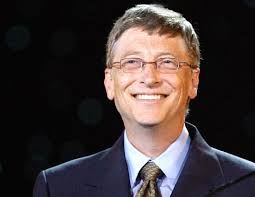
"Showing Up for Life: Thoughts on the Gifts of a Lifetime" by Bill Gates Sr.

"Eighty Percent of Success is Showing up."
Woody Allen, Comedian, Writer, Director, Oscar Winner

This is going to be a quick review, because it really was a quick read, but packed with great insights. I decided to grab this book a while ago after seeing a terrific interview with Bill Gates (Junior) and his dad (Senior) on Charlie Rose last year. Around the time everyone was raving about Outliers (Malcolm Gladwell's latest in a string of Bestsellers) here was the perfect example to prove Gladwell's point. 

Gladwell told the story of Bill Gates' life in great detail, outlining just how very impossibly lucky this kid was. But not only did he go to the right schools and live in the right town, he also had the right parents. And I think it's worth exploring how someone who works incredibly hard, and has made a lots of right moves, got a lot of that from his parents.

"Showing Up for Life" is not a Biography at all. It reads more like a letter from Senior to his family: each of his children, and his two wives (sadly, both were taken by terminal illnesses). Bill's maternal mother Mary, contributed a great deal to Bill's incredibly competitive nature. Early on, the Gates family, along with five other families, would head to wilderness for camping trips. Because they pooled their resources together, they were able to secure a cabin on the lake, where everyone could play games, and hold competitions of all sorts. Competition drove almost every aspect of life, whether they were playing capture the flag at Camp Cheerio, or playing a game of cards to see who got to skip out on washing dishes after supper. Mary had a knack for bringing fun to whatever they were doing.

That's a big deal. We sometimes think of these incredibly successful Entrepreneurs and think only in terms of dollar signs. We forget that this was the funnest thing in the world for them. In the Early Microsoft days, coding MS DOS for 12 hrs straight, then grabbing some pizza with your friends before going right back to the office again was really fun. Hey, they were geeks.

Also, to Gladwell's point, the charitable work that Bill and Melinda Gates are now doing did not start with Bill Jr. Some people, myself included, assumed he was an egomaniac, or was doing it because he felt guilty about his dominance in the PC market. Some even believe he just wants a Nobel Peace prize. But those people can't fully understand Bill Gates Jr, unless they first understand the man he strives to be: Senior had been involved with charities long before Bill Gates ever met MS co-Founder Paul Allen. In fact, Mary often asked her young children how much of their allowance they planned to give to charity.  

I thought it was amazing that Mary actually knew the CEO of IBM in the mid-80's, through their joint work with United Way. When he first heard about a little company in Seattle called Microsoft, he remarked, "Oh, that's Mary Gates' boy." And when Bill married Melinda in 1994 (up to that point, she was a product manager at Microsoft) her 'new job' became working on the charitable foundation full time.

And the idea of giving everything away goes a lot farther back than Bill Gates Sr. This would not be the first time Bill Gates was compared to John D. Rockefeller. Rockefeller was the greatest Oil tycoon there ever was, getting in at the turn of the 20th century, and ultimately becoming one of the greatest Philanthropists there ever was too. His legacy, passed down from generation to generation, is everywhere, from Malaria research to working on AIDS treatment, and helping famers in third world countries grow more bountiful crops. Everywhere Bill went, he saw the Rockefeller name. 

I don't want this to turn into a story about Bill Gates, because it's not. All the children are incredibly successful, which is kind of staggering. Bill Senior and Mary, and the way they chose to expose their children to new ideas, and new experiences, are the real story. And though Bill Senior, a lawyer by trade, was always finically well-off, they never seemed to let it go to their heads. In fact, there isn't a trace of ego anywhere with any of these guys. 

I found something striking with Bill Senior: being Christians and very rich, you would think they were fighting new tax bills left and right, as many talking heads on Network TV do. But if anything the Gates family is fighting for more taxes, every chance they get. Bill Senior actually got his start, when he returned from World War 2. The American recovery plan contained something called the GI Bill, which promised to pay for all those who served in WW2 to go to College. It was thought to be costly and extravagant at the time, but it worked: filling the offices and companies with young bright minds which would put America on a path to unprecedented growth. The Marshall plan was also widely criticized; the plan would put money forward to help America's allies recover from the ravages of War, but contributed to a sense of community and stability around the world.

These are two big pieces of legislation Senior picked out to demonstrate his inspiration for 'giving back.' And that's basically what a tax is: giving back to those who paid for the schools, the roads, the police departments that created the society in which you could, say, start a tech company. 

When I said I don't detect a hint of Ego in these guys, its more like, the Ego has grown. Sometimes we say 'WE' to mean our family, or our favorite team, or our city, or even our country (like in the World Cup). But what happens when it grows beyond that to mean the whole world? You feel pain when people on the other side of the world are hurting. Maybe that's why giving away 20 billion dollars, isn't just a 'nice thing to do' for these guys; but rather, it looks like so much fun.

"Dad, the next time someone asks if you're the real Bill Gates, I hope you say 'Yes.' I hope you tell them you're all the things the other one strives to be" 
Bill Gates Jr. Philanthropist, Technokid


Wednesday, June 09, 2010

"If You can Talk, You can Write" by Joel Saltzman


I got this book ages ago. It was only on my last visit back to my parent's place that I dug it up again, and knew I had to revisit its great ideas. 

But I debated putting this one up on the site. Is it about business? Hardly. Does it have anything to do with China, or Asia, at all? Nope. But it dawned on me, that one of my greatest assets, and one of my greatest joys, is writing. And even if you're not interested in Short Stories (something I've loved to do since I was a kid), you can still benefit massively from a book that will turn your annoying frustrating emails into a smooth lyrical flow. I swear this is true:  I actually get compliments from colleagues that my weekly progress reports are actually.... engaging and enjoyable and to read. I've found that a few guidelines can fix almost any piece of writing, and much of it comes right from this book.

One look at the title, and you already know the first message in the book: write the same way you talk. What a lot of people do is talk like normal people, but when they pick up a pen, or fire up the Word Processor, they start to over think everything, even before completing the first sentence.

"No, I've got to start somewhere else. No, I'll talk about this later. Now, how would I ask that?"

Stop trying to 'write', just talk on paper (on the screen). Write and write and write. Again, this isn't just about Short Stories or Novels. Everything you do. 

Writing an email to Mom? Get it all on down on the email. Write and write and write, and don't block anything. Forget about order of paragraphs, formatting and grammar. That's the easy stuff. The hardest part about writing is that the vast majority of people refuse to write the way they talk. They think that writing is somehow 'special' and everything must sound like a Royal Scroll from Her Majesty the Queen. They also think that they're smart enough to edit 'on the fly' and thus refuse to put anything down on the page, unless it's perfect. Stop that. See the delete key? It's your friend.

How much editing and erasing can you expect to do? A ton. 80% of your first draft is probably a confusing redundant mess. As Saltzman brilliantly puts it, the best writers usually end up with this on the first draft:

"Blah, Blah, Blah, Blah, Blah, Blah, Blah, Blah, Blah, Blah, Blah, GOLD!"

As a boy, I lived in the countryside, with little else to distract myself, other than reading books, and drawing. Like most youngsters, I had a vivid imagination, only I was, perhaps more than most, often in the position to write about it (or doodle about it). Fortunately there was encouragement to try writing stories in school; I wrote things like mysteries and fantasy stories. One in particular, seemed to be blatant copy of J.R.R Tolkein's Lord of the Rings ( of which I'd read about 10 pages before buckling under the weight of the tome) but it didn't matter--my third grade teacher thought it was neat since it was in French.

Around the age of 10 I was lucky enough to join a weekly Writers group, and the instructor would push us to think out of the box: writing an entire story with pure dialogue; writing an entire passage of very short sentences; taking a real life news clipping and then turning it into a full blown story with background, characters, etc. 

In high school, my favorite class was often English, where they encouraged us to get even crazier. Often the final exams included a prompt essay, where they would give you a choice of three words (say Dazed, Rapture, Harmony) which would 'prompt' you to write a 3 page exploration of whatever came to mind. Like Jimi Hendrix whipping and flailing for 10 minutes on a single snippet of a melody, you had to love the language to really nail it. Looking back, the keys were 

a) the ability to let go of your perfectionist mind,
b) the ability to visualize and vividly describe what you see in your mind, and 
c) the ability to edit the hell out of it, once the first draft was done.

As Saltzman reminds us "Writing is Rewriting." Any great piece of art, whether its a musical piece, or a great essay, or a beautiful engraving, has been drafted, and edited like mad. The timeless Comedian Jerry Seinfeld once commented that if he couldn't edit his jokes, he'd be nowhere as a professional comedian. He is a brilliant editor of jokes, more than just a very funny guy. Seinfeld admitted he often wrestles with a single line of a joke for hours on end. In comedy, if you can get a 10 word line down to 7, it's 30% funnier. That's the math of the laugh, I guess. 

When I was in high school, my English teacher, Mr. Digby, used the word terse. I love that word. Getting a 5 line paragraph down to 3, like Seinfeld, gave the words weight, and power. Editing creatively leads to writing that is layered, and a pleasure to read. But be careful: you have to walk the fine line between flowery puff (too many words, unclear, no direction) and boring writing (just the facts, no life, no pizazz). And to be honest, that's Editing. Writing is Rewriting.

So let's take a step back, for those who may not be interested in Creative Writing, but have to write everyday for work, and wonder how to improve it (this is huge for those for whom English is a Second Language). The key to great emails, or great memos, around the office, is to read what you wrote aloud and be diligent in your editing. Note: I said aloud, not loud. Just read it to yourself, and stop whenever something sounds wrong, or not what you meant it to sound like.

 Just as before, if you can say it in 1 line, instead of 2, that's progress. If you can use 10 words instead of 15, that's improvement. Also, consider the tone of the writing. If you're writing a prospective customer, don't kiss his butt too much, but don't be cold, and lifeless either. If you're writing to your boss, you want to sound confident, but not overstep your bounds. Never ever give off the air of arrogance or know-it-all-ness to your bosses and managers. Just read your own work aloud, and ask yourself if that is how you meant it to sound. If you can talk, you can write. If you read it to yourself, the problems and strengths of the emails will be immediately apparent to you. You may need to read through the whole thing 3 or 4 times to get it just right. 

Do you really think I just one-off these blog posts? No way. I don't post these until I've read the whole thing out loud and have smoothed out the rough spots. Things you wouldn't even imagine will come out... like a huge gap in logic between two paragraphs. Or a word that's been used 4 times in the span of 2 lines. That's a no no. It's lazy writing.

OK you read it out loud, but it's still not Shakespeare. Wanna see more of your mistakes? Take a couple hours off, go for a walk, catch a movie, go play sports. Then come back, you won't believe how 'wrong' your first draft was. And your 2nd draft will be great.

Want to do even better than that? Take a day off. Or a week. The goal here is Objectivity. The more of it you have the more you'll know what the reader will think of when they read your work. And that's how you right something that sounds as great and reads as smoothly as 'Catcher in the Rye'. 

That's good public speaking. And that's good writing.

I've tried to summarize some of the great ideas, but there's a ton more in here. Joel Saltzman has written a book that oozes the love for writing from every page. If you're the creative type and have always wanted to turn your unique stories into a career as a writer, definitely pick this up.  Even if all you do is turn out the greatest emails your boss has ever seen, it's worth it.

Monday, May 31, 2010

"Good to Great" by Jim Collins

This book came out almost 10 years ago, but within its pages, are some of the most thought provoking results on Business Excellence. Actually, Excellence in general. The great thing about studying Public Companies is that we can study their freely available numbers, we can break down their acceleration of growth, and we can talk to their bosses and innovators.

And that's exactly what Jim Collins and his team of researchers did. They found a handful of companies that had huge sustained growth for 15 years and asked "What are they doing? How did they get here? Why are they so rare?"

What they found were a string of totally non-MBA answers. A few simple concepts and only 10 or 20 leaders in the country could hold themselves to. Wow.

First, the leaders: we know that leaders in business can be very loud, very cool, very power hungry and egotistic.But these types of characters were nowhere to be found in the study. What did the leaders of these great companies (like Nucor, Gillette, Wells Fargo) have in common, when it came to leadership?

Diligence, and Modesty. That's it.

If you can find a guy or girl who will work all day and all night, and will do whatever it takes to rigorously do the homework (on the competition, on new technology, when it comes to hiring, when it comes to expansion), who is modest to a fault, that's your future CEO.

And they discovered something remarkable about their compensation too: it doesn't make a difference.
All the nonsense and backdoor deals going on on Wall Street, and here's a group of the best companies in the last 15 years, according to Wall Street, and the compensation was not a motivating factor, and did not move the stock price up or down. So what was it then?

These old fashioned, hard working, modest guys just wanted their company (not themselves) to grow and be great. Part of that modesty the leaders were not going for glory but diligently, and rigorously, doing the hard things to promote the company, the group, the collective. And here's a crazy thought: if you really want your company to be great, you'll set it up so that it will continue to be great, even after you retire! How many retired CEO's do you know that lose sleep thinking about their old company?How many companies have you worked for, that you've worried about, long after you'd already left the job? That's real passion, loyalty, and care for the company. And it's rare.

There's another theme that really hit home for me, on a professional level and a personal level. They call it the Hedgehog concept based on an old parable of the Hedgehog: 


In the woods, the Fox is always trying to eat the Hedgehog, but never succeeds. He tries various tricks, pouncing in the day, pouncing at night, being slow, being fast, luring the Hedgehog, or a surprise attack, but he just fails and fails and fails. The Hedgehog, with none of the speed, agility, or aggression of the Fox, survives with one simple defense. Whenever it sees the Fox coming, it just rolls up into a ball with those spikes out. The Fox can do nothing when the spikes are out, so it eventually gives up and wanders off. The Fox goes hungry and the Hedgehog thrives.

How could such an weird looking creature be the basis for business and personal excellence? By sticking to one thing. Basically, the Fox can be compared to a company with tons of great technology, a bunch of different projects, and lots of resources. By bouncing around to different things, it never really focuses its energy on one thing. And why does that matter? Because it never gets to be the best in the world at one thing that way. And so you never hear about them.

As people, we can consider the Hedgehog an inspirational figure of sorts: it is born with this one talent, or trick. It exploits that talent every single day, and as a result it thrives. It doesn't aspire to be like the Fox in speed and agility, and even grace. It just plods along, and slowly but surely, becomes great at being...a Hedgehog. Think of a Comedian that works on this one set of jokes, for 15 years. For 15 years you never hear about the guy, and then suddenly, BOOM, he's everywhere. You start seeing clips on Youtube, you hear he has a new TV show and movie deal in the works, and your friend think he's the funniest thing on Earth. Thats how it happens. Not overnight, but a long, gradual, almost mundane process, of sticking to one great thing.

Back to business, we found that this is one of the hardest things for great companies to do: say no to trendy, cool, hot new projects that threaten to pull the company far away from their core excellence.
For example, in the book, the American Pharmacy Wal-Greens decided they wanted to be the most convenient pharmacy in the country. That was it. Once they had that idea, all decisions were easy. It meant doing some crazy things, (like closing a store, only to reopen a store a block away with better access from the main traffic routes, etc) but it got them all the answers. If you can prioritize, you can answer any question. And you can only prioritize if you have rigor and discipline.

The first two factors of the Hedgehog concept are Passion and 'Best in the World Focus.' The third and final factor is, at last, about money. After all, I didn't say these companies were the coolest in the US (a steel company and a drug company?), they were being highlighted because of their consistently excellent performance on the stock market.

The final factor was choosing a metric that defined how they measured excellence, and zeroing in on that target. These guys could aim to maximize profit per store, profit per employee, profit per country, profit per customer visit, anything they wanted. And each one had its own implications for future plans. The bottom line is this, the third factor is the way the company measures how well people are doing their jobs. Walgreens wanted to maximize profit per customer visit. That meant every time someone walked in the door, all the advertisers had done their jobs. Now it was time to see just how great the experience was to be in a Walgreens store. If it was great, profit would trend up. If it was confusing, noisy, over crowded, empty shelves, rude staff, the profit would trend down. It's that simple. By zeroing in on this one metric, Walgreens beat the market by a mile, year after year after year.

There's a ton in here, that I just couldn't get to. If you're into it, go pick it up, its a great read, lots of amazing anecdotes in here. Yes its a business book, and yes I've got some terrific ideas for my own job, but you can get a tremendous amount of personal insight as well. Here's food for thought : what one thing can I do, day in, day out, and eventually be the best in the world at?

Friday, May 21, 2010

"Meeting the Shadow: The Hidden Power of the Dark Side of Human Nature" edited by Connie Zweig and Jeremiah Abrams

After another bout of writing, some to do with Psychology, I was reminded of an incredible book that I should share on here, about peeking into the Shadow. This is really mind cool stuff-- a collection of short essays on the 'Shadow'...not to be read front to back, but nibbled on.

If you're not familiar with the term, "Shadow," Psychologists Sigmund Freud and Carl Jung bandied about terms regarding what they thought made up a Personality, namely, what is the process of Human Personality Development. This is all very obscure stuff to measure, of course (being Psychology), but after 20-30 years of dealing with a vast array of Psychological traumatized patients, and finding patterns, some these two mavericks had a great base of experience to draw from. Even more fascinating, they both made detailed records of their dreams, and analysed the symbols therein (leading to some of Jung's most provocative work on Archetypes). What arose, in one form or another, was a theory of development whereby the Human Personality is said to split into the Persona, and the Shadow. Basically, the whole 'Self' (you and everything about your personality) is split into the Good part (the Persona) and the Bad part (the Shadow).

Before I get attacked for using such childish language here, the "Good" part is not necessarily good; its only good because Society says it's acceptable and polite. The Bad is not necessarily bad at all, except that Society says it's inappropriate or unsuitable for public display. (As you can imagine, this means Shadow and Persona traits likely vary from country to country, and change over time, as society's norms change).

Remember when you were in primary school, and a teacher told you not to speak out or make jokes in class. Maybe you liked to ask very interesting or unique questions in class, and the teacher told you to be a good boy/girl, and only ask 'good' questions. Maybe you told your parents you wanted to learn the electric guitar, and they said you couldn't because they didn't want you to hang out with a 'bad crowd.' When we are very young, we are free of hindrances, brashly expressing ourselves, like little Emperors and Empresses.

"I'm hungry!" "I'm bored!"  "I want candy!"  "I'm not sleepy, I wanna stay up!"

Society eventually nudges us in the "right" direction, by telling us what we should and shouldn't do. This is why we need a Shadow. We need a place to put all those 'bad' character traits.

In terms of Personality development, as soon as we learn certain things are 'bad' and certain things are 'good', we subconsciously remove certain elements of our personalities from 'public display.' That is, we take certain parts of our personality and put them into the 'Shadow.' All the things which society says are 'acceptable' become the Persona. The result? Most of us are civilized men and women, following the rules, waiting for the right traffic light to go, and waiting for the right signal to approach and talk to our fellow man, never acting on impulse, always subconsciously calculating to do the 'right' and most 'polite' thing. Subconscious is the key here. To stay sane, and stay congruently in Society, the Persona must act as if the Shadow doesn't exist.

As it turns out, if we are very 'good' people, much of our 'life energy' is trapped in the Shadow. We are essentially living half of our true personality, and putting half our personality, half our impulses and half our desires, in a prison of sorts.

Sometimes, in the midst of a trauma, a crisis, or an emotional breakdown, the Shadow will 'break out of Jail' and let itself be known. Also, if we ignore it long enough,  eventually it will burst onto the scene, with all its wild impulses and outrageous ideas. After all, if we follow the 'Persona' all our lives, and don't feel happy or fulfilled or loved, eventually the Shadow's nagging whispers will start to make sense! Perhaps not surprisingly, in addition to life energy, much creative energy is locked up in the shadow. After all, whats could be more boring, than a movie, TV show, or song spawned from dozens of intermingling 'acceptable' and Politically Correct traits and feelings.

'Meeting the Shadow' not only outlines much of Carl Jung's ideas (which did differ greatly from Freud, by the way) on the Shadow, it also outlines potential strategies for bringing the Shadow to the for (hence the title). The goal is not to become crazy. The goal is not to go on a wild killing spree. Locked up in the Shadow are very good traits, the problem is Society has given broad generalisations to young impressionable Children who then took it to the extreme.

"Don't Yell"
"Boys don't cry"
"Girls don't talk like that"
"Always wait your turn"
"Be nice to people older than you"

These may be good guidelines for young people, but as rules to live by they are ludicrous. Never Yell? Ever? Is it also a bad thing to get mad? Is it a Sin to ask for something, like food, or attention, or love? Also, if an older person is abusive to you (physically, emotionally, etc) should you let them??

As you can see, as we get older, we absolutely must examine the 'over-simplistic' beliefs  and rules we had as a child. If the Shadow goes ignored, it results in lifeless slugs, dead on the inside, from lack of expression, slaves to their childhood masters. Not only are they unattractive to the opposite sex, they are unattractive employees, and unattractive friends. Those who do not reconnect with the Shadow, ultimately become Zombies, constantly in fear of 'crossing the line' and occasionally snapping in a burst of 'Shadow' fury.

I know what you're thinking. Yes, sometimes these 'bursts' where the Shadow demands to be heard can be dangerous and shocking. It would not be surprising to hear that a normally quiet and subdued man woke up one day, mad at the world, mad that he's done everything 'right' and is still sad, lonely, and wretchedly poor, and suddenly gave into all of his Shadow instincts at once, possible attacking or hurting people in his apartment building or office.

Another fascinating consequence (according to Jung's work) of having an overly 'heavy' Shadow, is that we project those 'bad' traits onto other people. After all, if I'm such a good boy, then the only source of 'rude' and 'selfish' behavior in the world, must be other people, preferably people of my same gender, but from another country, or social class. It's incredibly common to hear ourselves or others make comments like "Everyone from [City X] is a jerk" or "I don't know, I just think people who [play badminton, drink espresso, write blogs] are the scum of the earth," and when we hear that, its the Persona bashing the Shadow. The Persona is saying, I don't like these traits so I've projected them onto people who play badminton, or work on Wall Street. Yes, this has dozens of implications for not only Racism, but also Wars. We have a situation in the US right now where Mexicans are being characterized by some as 'unfairly cheating' and 'trying to take our way of life'. Trying to build walls (or in Arizona's case, a fence ) to keep the Shadow away, is at once hilarious, and deeply sad.

If you can cut the Shadow down to size, and bring more Shadow traits to the fore, you can cut down on this insane Blogger bashing. Anyway, the goal here is not to go crazy and delve into the most bizarre impulses, but to get back that energy, that's locked up in the Shadow. The relaxed, cool, eccentric man understands and is curious about his dark side, and occasionally expresses it through art, or poetry, and is never afraid to stand up, and 'selfishly' ask the questions he's burning to have answered. Moreover, if his house is robbed, or his is physically threatened, he needs to channel his Shadow energy to protect them, not be the good boy.


A basic understanding of the Persona and Shadow complexes (that's what they are, just ideas, not actually real 'areas' of the brain, etc) helps guide us to understanding the Ego--how we can tame it, and how we can harness it. Perhaps I will write more about this in future.

Wednesday, March 24, 2010

Staying on the Path. "Mastery" by George Leonard

Mastery is a funny thing.. we usually use the word when we consider someone to do something effortlessly --like playing the Piano, speaking a foreign language--especially when someone is able to be creative and playful with a particular skill. We think, 'he's so comfortable, he's such a master in the kitchen, he was able to come up with his own recipe for this delicious Tomato Sauce!' And of course, we'd all love to get to that stage, in our jobs, in our hobbies, and in our relationships.

George Leonard started off in the US Army, becoming a 'master' of flying bombers/jets and became a teacher in that field. After the Second World War, he stumbled upon Aikido, and soon fell in love with the martial arts. He has long since achieved several levels of black belt and started his own Aikido academy. The path of Mastery he describes is based on his own endless journey towards 'Mastery' of Aikido. Towards, not to.

Is this book about Martial Arts, or landing Fighter Jets? Of course not. This book is for anyone that ever picked up a tennis racquet, tried to learn a new business, learn a language, monetize their hobby, or get serious about their fitness. Pretty much anything you do, can be taken to the level of 'zen-like' practice. This word practice is very important. We're not talking about 'practicing free throws' or 'practicing Calligraphy', but practice as in, 'he's been practicing Medicine for 20 years in that same small town.' The word, not surprisingly, conjures images of wise old masters from the Shinto age, in deep states meditation.

And why would you want to treat your Golf swing like an Ancient Monk would?

Because that's the only way you'll enjoy it. And that's when you'll really get good at it.

Leonard describes how most people pick up a new hobby or sport (eg. Rollerblading, Cross Country Running, etc) and how people find various ways to get frustrated/bored in the very early stages, and give up. Mastery should then be redefined not as 'being perfect at something', but 'staying on the path' not just for a while, not just for a few years, but for the rest of your life. Leonard himself can be considered an Aikido master, but he doesn't think so. He still sees ways to improve, ways to be more focused, ways to be more in the moment.

He mentions the tireless dedication of NBA legend Larry Bird in his own 'practicing.' Often showing up to the gym 2 hours before anyone else, not just practicing shooting, but pushing the limits of what would be possible, even practicing lobbing shots in from the 5th row. Countless excercises--dribbling, shooting, passing--thousands and thousands of shots that no NBA fan would ever see. What could possibly push an athlete to do this? Fame? Respect? Money? Not likely, fame and respect were already achieved in college. Money as a motivator probably would have put Larry Bird in Law School, not the basketball court. At any rate, he had that a couple years into his career, and still outworked everyone on the court late in his career.

The truth is simple: Larry Bird (and Jordan, and Magic Johnson, and Kareem) wasn't motivated by external things. He really loved to practice. His excellence on the court was just a consequence of his pure joy during practice time.

Our obsession with results is the number one thing ruining our pursuits, and standing in the way of Larry Bird-esque results. So where does it come from? Turn on a television and you'll get a hint: as Leonard describes, our modern consumerist culture, as portrayed on TV, is a series of... ahem... 30 second climaxes (whereby a product solves all your problems in a moment of pure ecstacy), interrupted by 30 minute stories, easily solved by happenstance or dumb luck. Life is so easy. The message: 'If you can't figure something out in 30 minutes, it's probably impossible. And not worth it anyway.'

If you hate to learn, try new things, make mistakes, you will drop out as soon as you possibly can, or keep going for a long time with mediocre results. Consider this book the guide to cultivating a love and joy of practice, and that is the true key to excellence.

Saturday, February 20, 2010

Think Week

If you haven't heard of Bill Gates' Biannual Think Weeks, this is going to sound pretty crazy: he actually takes off, unplugs, and hides in a cottage twice a year to read books.

I know what you're thinking "Read books? That's so...old fashioned."

Yeah, he's done it for years (well, since he was able to afford a cottage in the hills). It used to be that he would read lots of weird books (really geeky stuff) on Computer Programming, and Financial Instruments, and Business Models, etc. These days, he reads an insane amount of stuff that all comes internally from Microsoft.

Managers at the software giant have 'homework' to hand in to Gates, who spends a week in silence, sipping Orange soda and making notes.

To me, the idea of this guy, worth about 60 billion, trudging up to some remote cottage to 'mark papers' from his employees of 'average intelligence' is just hilarious, and at the same time, inspiring. Even now, he still feels he has a tremendous amount to learn and still strives to be the smartest guy in the room.

So alas, there I was, pondering what to do with my Chinese New Year 'holiday.' I could go to Thailand or Japan, or Sanya, etc. All places which would be expensive/packed for the holiday, and I wouldn't be able to check emails if I was having too much fun, etc. Then it dawned on me... where can I go, where I'll have peace and quiet, and can actually do something productive, ala Gates?

If I stay at the apartment, its way too noisy, and I'll get sidetracked with Internet, Movies, Friends etc.

I actually found a middle ground: I got a hotelroom on the outskirts of Shanghai. A nice one, with internet on the first floor, and room service, out in the far west (near the airport). Minimal disruption, minimal fireworks (99% of the time), and I took a bunch of books.

And you know what? I can probably get away with doing it twice a year. Like I said, I can check emails daily, in the morning, survive off room service, and the amount of time I have devoted to just reading great books (preferably about your line of work, keeping up with the very latest trends in your job, or big picture stuff, like Gates) can be of huge benefit to your company.

One thing I will say, the amount of 'Wow' great ideas I've gotten from this week is astounding. That's how the brain words, you fill it up with 'information' and then it digests it over the course of a few days. It'll rattle around up there, and suddenly BAM, you get the answer to something that was puzzling you (about business strategy, about time management, or about how to get financing on the next big project).

Think about it... you could worse than emulating one of the richest (and smartest) guys alive.

Friday, February 19, 2010

"Synchronicity: An Acausal Connecting Principle" by Carl Jung

What is an amazing coincidence? Is it magic? Is it just impossible luck? Maybe its nothing more than a roll of the dice that the you wake up one day, and you have the flu. As a result you don't go into work, and a few hours later there's a huge snowstorm, and the afternoon rush hour roads are jammed and your colleagues don't get home until 10PM that night. In such a case, you feel blessed to have gotten the flu. But was it just a coincidence, or, was it written, somehow?

One could theorize the weather and your sickness were related. But sometimes, just sometimes, there cannot be any connection whatsoever, and the only two 'explanations' are that you've witnessed a) an amazing coincidence or b) a miracle.


I've wanted to read this book for a number of years; I've been a huge fan of Jung's work since I started reading his amazing insights into personality development (Id, ego, projection, etc). Synchronicity goes beyond those 'theories' of psychology and borders on the paranormal.

Synchronicity, I assumed, was his theory to explain the occurrence of unbelievable 'magical' circumstances, and perhaps, what they can tell us about ourselves. Be warned: although this is only a 120 pager, this was academic piece from a brilliant man, written in 1960. In other words, put the coffee on.

Having read it, I can't believe where Jung went with this idea. Having first introduced the notion of causality and 'connected events' he posits that in such a complex world, it would be easier to start by looking for events that are unique-- they are indeed rare. Connected events are everywhere. He delves into rigorous statistical analysis of card games and dice games, and concludes that ESP may be possible, as well as 'willed outcomes' (Think, The Secret).

This is where Jung gets going. He puts away the calculator for a second and turns to.... Chinese Philosophy?

Having first pondered the possibility of ESP/Psychics/psycho-kinetics, he then discusses several ancient systems of divination, preferring the Chinese (Like the 'Yi Ching') for their holistic approach (again, almost everything is connected). He goes into a very spaced out and esoteric trip consisting of galactic forces (in attempt to prove or disprove Easter and Western Astrological forecasts) and Greek Gods--seriously--knowing that all these things are man's 'creation', the common link is, Archetypes?

Archetypes are an idea of patterns, figures and characters that are common throughout the world's cultures and eras. These seem to be models for possible personalities and relationships which are so universal as to be, perhaps, wired in our DNA to understand (eg. The Hero, the Trickster, the Nurturing Mother--these are ingrained ideas which Jung believes compose our dreams).

This is really an amazing book whereupon, Jung attempts to sit down and prove the power of our minds to either predict the future or create it. I won't spoil the end, because I won't do it justice, obviously, but I'll share an anecdote, which occurred just after I finished reading the book.

It just so happened that during my Think Week, I'd finished a book called 'The Ascent of Money"the day before. Now, there's a part in that book which mentions Mary Poppins: apparently, there's a scene in Mary Poppins where everyone wants to take their money out of the bank at the same time, causing a run on the bank's money. Why do I mention it? Because just before going to sleep that night, and I was watching some TV (keep in mind, this is China, most of the Channels are Chinese talk shows and dramas). I stopped on what looked like a very old movie, with some old-looking white people. It was Mary Poppins.

Why is that weird?

Well first of all its about 50 years old. Secondly, its geared towards a North American audience, making it less liklely to have any appeal whatsoever in China in 2010. The fact that I remembered 'Oh yeah, I was just reading about this yesterday' was amazing. And I'd actually bought that book 'The Ascent of Money' about 6 months prior and never got around to reading it until then. It's amazing that I just so happened to get the book, and then let it sit on my coffee table for half a year before, in the right hotel, on the right week, watching the right channel at the right time, Mary Poppins shows up. And it would have been completely meaningless unless I'd read Ascent of Money they day before, instead of the day after.
You're right, I'm probably just grasping at straws there. Or maybe Synchronicity is just a matter of paying attention to the millions of coincidences and miracles that happen every single day.

Thursday, February 18, 2010

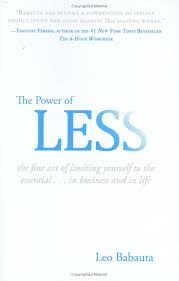
"The Power of Less" by Leo Babauta


I'd already been interested in the a more simplified Zen lifestyle (I've been meditating daily for a couple years now) and picked up this book because the title was so representative of my direction recently: less stress, less hassle, stop messing around and focus on the things and people that are really important to me.

This book is not just a 'guide' for doing less; it seeks to bust what I call the Multitasking Myth: that is, it emphasizes that by doing 14 things at once (MSN, Emails, Music, Twitter, Sending Text messages, Eating...etc) you're actually way less efficient. You're way more stimulated but way less productive.

(Note: there has actually been a bit of talk on 'Multitasking' recently on the web with the recent launch of the Apple iPad, which, unlike a real computer, is generally designed to run just one program at the same time. Techies screeched, "How can you get anything done without Multitasking?"... Ironically, it might be a great built in 'feature')

In this sense, at its core, the message is to 'unitask'. Focus on the task at hand, and finish it. In the same vein as Tim Ferris (http://www.fourhourworkweek.com/blog), Babauta is a big fan of batch processing things. Everything from Email to Errands, Bill Paying etc. And it struck me that its actually a very popular idea: just ask Henry Ford.

We've known the power of specialization of labour for so long, so... why are we so hung up on the idea (rather, the myth) of doing a bunch of different things at once? The truth is, to really hit your productivity groove, you gotta turn off the music, get off Facebook, and focus. The productivitity gains are amazing. I know, I know, the great thing about Multitasking is the flexibility, and the time-saving that comes from driving while you play with the your Blackberry, yada yada yada. Come on, what kind of brilliant writing have you done halfway through a Big Mac? Be honest.

Ok so that was just one element of the book, but I think it exemplifies what we're trying to do here, 'Power of Less' doesn't mean you're doing less, you'll actually do a ton of things, the point is less distraction and less wasted energy on things that, frankly, don't really mean much in the long run.

A big section of the book, Babauta talks about nailing 6 month to multiyear goals by breaking them down and, again, focusing on just a few goals concurrently (you could do just 1, ideally, but there are often time gaps between certain objectives, and we don't want to waste that time idly.)

If you find yourself getting sidetracked easily at work, (it's normal, we all do) definitely check this book out (as well as the aforementioned Tim Ferris classic, 4 hour Work week).

Follow this author on Twitter@zen_habits

Node Zero: "Love is the Killer App" by Tim Sanders


For my first review, I want to go back to the first book that sparked me to get into business. It was early 2000's, and I was working like a dog. At a factory. While I figured out what I was going to do with my life. Everyday after work, I'd get home and eat in front of the TV. Usually around 3 or 4 in the afternoon, there would be some 'Biography' or 'Inside the Actor's Studio' on, and I was always really into those, hearing about brilliant people, and their humble beginnings.

It was around this time that I saw the story of Bill Gates and how Richard Branson started his empire when he was 16, etc. I was buzzing off these 'interview' shows, and there was something about them that really turned me on, I wasn't sure what it was, but each one had a nugget of genius, and I felt that if I could just keep getting the odd nugget of genius, maybe I could find what I wanted to do with my own life.

Flipping the channels one such afternoon, I stopped on a local access show because there was this wild looking hipster guy, with purple tinted shades passionately talking up a new way of doing business. I listened with rapt attention, as this guy, Tim Sanders, tore apart every negative stereotype about the big bad world of business.

"These sharks don't last"..."No one wants to be that cheesy guy at the Office"..."I love my Company"..."The people I work with are rockstars!"

Before I even knew what company he worked for (Yahoo!) and what his 'job title' was (Chief Solutions Officer) I knew I had a lot to learn from this guy. He was living the existence I'd always dreamed of, basically he was a Businessman with a Conscience. No, scratch that. He was a Passionate Businessman! And he wasn't just scraping by, he had landed a huge role at a huge company that had their pick of pretty much anyone for that job. In other words, his 'passion' wasn't a fluke, his conscience, his authenticity was a core element of how he did his job! It was the thing that set him apart from everyone else! At the time, it was a real revelation to me that being anything other than a slimy salesman could be an... advantage in the workplace.

He'd written all his ideas down in a new book, and within days I was delving into "Love is the Killer App: How to Win Business and Influence Friends." Tim breaks down his holy trinity of Bizlove: Knowledge, Networks and Compassion. This was so huge to me then, and now, looking back, it's still a rarity to find people who act the way this guy lives.

The idea goes something like this: you can actually have really close relationships with great people in the office, it doesn't have to be cold, and it doesn't have to be cheesy and fake, but you have to have to know you're stuff first. And for that, you have to hit the books, and you have to become a social animal, networking the right way.

In order, reading great books, applying their knowledge, sharing it freely with your growing network, and then, when you have demonstrated to people that you know your stuff, then you can start building sincere relationships with people. If you do that, you'll almost never lose a sale, you'll almost never be undercut by a competitor, because it won't be about dollars and cents, it'll be a sincere partnership, in a sea of Machiavellis.

If you don't know anything, and start making promises to the customer (eg. all your prospects) and then let them down, you are the cheesy guy. You're the shark.

At the end of this great book is a killer Reading list to get the newly indoctrinated on their way, not only Business books, but books on Tech, books on Out of the box thinking, and books on ...Love.

I couldn't recommend this book more highly, and if it isn't already obvious, Tim Sanders' ideas are what led me to eventually studying Business in school, and even doing this very blog. Tim Sanders, among other things, is the anti-Cynic, and I believe, that should be enough to get you to pick up his book. Once you get a few pages in, you'll be hooked.

Follow this author on Twitter@sanderssays