Wednesday, March 24, 2010

Staying on the Path. "Mastery" by George Leonard

Mastery is a funny thing.. we usually use the word when we consider someone to do something effortlessly --like playing the Piano, speaking a foreign language--especially when someone is able to be creative and playful with a particular skill. We think, 'he's so comfortable, he's such a master in the kitchen, he was able to come up with his own recipe for this delicious Tomato Sauce!' And of course, we'd all love to get to that stage, in our jobs, in our hobbies, and in our relationships.

George Leonard started off in the US Army, becoming a 'master' of flying bombers/jets and became a teacher in that field. After the Second World War, he stumbled upon Aikido, and soon fell in love with the martial arts. He has long since achieved several levels of black belt and started his own Aikido academy. The path of Mastery he describes is based on his own endless journey towards 'Mastery' of Aikido. Towards, not to.

Is this book about Martial Arts, or landing Fighter Jets? Of course not. This book is for anyone that ever picked up a tennis racquet, tried to learn a new business, learn a language, monetize their hobby, or get serious about their fitness. Pretty much anything you do, can be taken to the level of 'zen-like' practice. This word practice is very important. We're not talking about 'practicing free throws' or 'practicing Calligraphy', but practice as in, 'he's been practicing Medicine for 20 years in that same small town.' The word, not surprisingly, conjures images of wise old masters from the Shinto age, in deep states meditation.

And why would you want to treat your Golf swing like an Ancient Monk would?

Because that's the only way you'll enjoy it. And that's when you'll really get good at it.

Leonard describes how most people pick up a new hobby or sport (eg. Rollerblading, Cross Country Running, etc) and how people find various ways to get frustrated/bored in the very early stages, and give up. Mastery should then be redefined not as 'being perfect at something', but 'staying on the path' not just for a while, not just for a few years, but for the rest of your life. Leonard himself can be considered an Aikido master, but he doesn't think so. He still sees ways to improve, ways to be more focused, ways to be more in the moment.

He mentions the tireless dedication of NBA legend Larry Bird in his own 'practicing.' Often showing up to the gym 2 hours before anyone else, not just practicing shooting, but pushing the limits of what would be possible, even practicing lobbing shots in from the 5th row. Countless excercises--dribbling, shooting, passing--thousands and thousands of shots that no NBA fan would ever see. What could possibly push an athlete to do this? Fame? Respect? Money? Not likely, fame and respect were already achieved in college. Money as a motivator probably would have put Larry Bird in Law School, not the basketball court. At any rate, he had that a couple years into his career, and still outworked everyone on the court late in his career.

The truth is simple: Larry Bird (and Jordan, and Magic Johnson, and Kareem) wasn't motivated by external things. He really loved to practice. His excellence on the court was just a consequence of his pure joy during practice time.

Our obsession with results is the number one thing ruining our pursuits, and standing in the way of Larry Bird-esque results. So where does it come from? Turn on a television and you'll get a hint: as Leonard describes, our modern consumerist culture, as portrayed on TV, is a series of... ahem... 30 second climaxes (whereby a product solves all your problems in a moment of pure ecstacy), interrupted by 30 minute stories, easily solved by happenstance or dumb luck. Life is so easy. The message: 'If you can't figure something out in 30 minutes, it's probably impossible. And not worth it anyway.'

If you hate to learn, try new things, make mistakes, you will drop out as soon as you possibly can, or keep going for a long time with mediocre results. Consider this book the guide to cultivating a love and joy of practice, and that is the true key to excellence.

Sunday, March 21, 2010

Update: www.21tiger.com now up and running.

Over the weekend I moved 21tiger over to its own domain. Got a new email address too.

I've also revise the tags system on the right hand side. Post should correllate to one or a few of nine main topics. Of course, it will still be framed with ideas on Asian Culture, Business, and Language, as that's a big part of my life these days. I promise it will start to make sense over time. ;)

Health
Spirituality
Family
Personal Development
Money
Philanthropy
Career
Friendship
Love

Cheers,
Michael

Tuesday, March 16, 2010

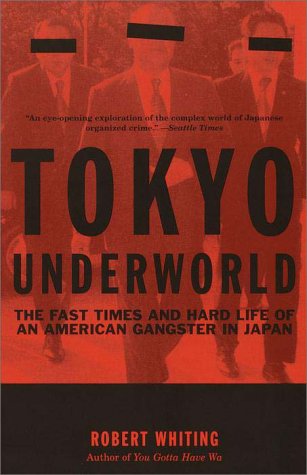
"Tokyo Underworld: Fast times and Hard life of an American Gangster in Japan" by Robert Whiting

I've spent time in a few countries around Asia, but never Japan. In my life I've probably met less than 5 Japanese friends, so studying the language didn't really appeal to me. I studied Mandarin early on and ended up working in China, and I've always been clueless about the combination of classic and quirky in the Land of Rising Sun.

So the first Japan book is all about the Yakuza, rather than Hello Kitty.

Okay, okay, let me be clear, I'm not going to make any generalizations based on a book about crimelords. This is a really fun interesting book, not gruesome or overly violent as you might expect (seedy at times, devoid of morality, perhaps), and just a fun way to get into a totally foreign culture (apart from Sushi, Slam Dunk comics, and the Karate Kid movies).

At the outset of the book, I was pretty excited to learn of Japanese History right after the Second World War. What followed WW2 remains the most amazing Economic turnaround in history.

How long did it take the Mob to recover? It turns out that within 3 days of the American Treaty, the Gangsters were already in action in the Shinjuku, Tokyo and what follows is 300 pages of a crude, crass, corrupt and cold blooded account of those who survived and thrived there.

The book follows an American GI with balls of steel ( tough talkin' Italian New Yorker named Nick Zappetti) who gets in early for the booming Japanese recovery, builds an Italian restaurant Empire and has to fend off would be conquerers.

The whole story is about, brace yourself, bribes. Bribes, bribes and more bribes (in that sense it was very educational!). Everything good that happens in this account is a long chain of payouts under the table, and of course, the anti-Americanism builds throughout the book as the Japanese economy roars back to life (with confidence, the locals grow weary of the Westerners).

We follow a cast of gangsters, grifters, wannabes, and of course, hookers. But while almost everyone in the book is what you might call 'a bad seed' the inner working of business (which goes all the way up to the Japanese political structure and American espionage) are amazing. Much of it was reminiscent of Perkins "Economic Hit Men" but with all the delicacy and stubbornness of Japanese 'Wa' (meant to maintain harmony amongst all things). Ultimately that was the most provocative part of the book: not the hellish violence, or immature cavorting of multimillionaires, but the way Japanese maintained 'face' and their own sense of Japanese integrity, amidst a modernizing and ever more international environment.

The book closes wistfully as we say goodbye to the great Nick Zappetti, a foreigner who's seen the best and the worst Japan has to offer.

Saturday, February 27, 2010

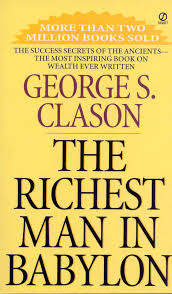
“The Richest Man in Bablyon” by George S. Clason

So I have to preface this review by saying,

a) This book was written in the 1920's.
b) This is a book about personal finance and budgeting.
c) I absolutely love this book and had so much fun reading it, I went back three more times!

Ok, let me explain: I actually bought "The Richest Man in Babylon" in Audiobook form about a year ago. There was a time when I would incorporate Audiobooks into my morning routine (multitasking), but now prefer the selection of Amazon.ca hardcovers and convenient delivery. If you want to pick this up on Audible.com, or download the Audiobook from iTunes, it is an absolute treat. If you get the actual book, it's pure genius and full of charm, but you won't get the great voice acting.

I know. Voice acting? Here's how it works: Clason was a businessman and early 'motivational' guru and would travel around the US distributing pamphlets that would show people how to save money, and build wealth. He didn't just say, 'Do this, do that', though; instead, he created parables set in Ancient Babylon, which would be more engaging and enjoyable to read than the driest subject on Earth...personal finance and budgeting.

So now you can imagine why I had so much fun 'listening' to this book. Set in Ancient Babylon, it tells tales of common men getting together to discuss how they can emulate the local hero, The Richest Man in Babylon (who himself, was a self-made man). The whole thing, as a parable, is one huge metaphor. First you fall in love with the story, then you feverishly jot down notes as you realize just how brilliant this is. The Babylon setting simplifies the whole thing into great archtypes, not overly confusing 401k, IRA, gibberish (which by the way aren't strategies at all, they're just tools).

As the richest man in Babylon relates in this book, even he can't afford to satisfy all his desires, and his stomach cannot fit all the food he might desire to eat each night. Even he is limited by the time on this earth, so he spends his time carefully (budgets his time?). Even he, with all his endless wealth, has a budget. And that budget works for him to make sure each meal is delicious, each hour is spent thoughtfully and enjoyably, and each dollar is spent usefully and intelligently. And here's the kicker: when he eats, he does not mourn that which had no space to eat. He is content with his choices.

Ok. So, so far, absolute gibberish and fluff, right? First we have to get past this idea that you have a money problem. You don't. If you made a million dollars a year, your bad habits would scale and you'd be just like those guys who win the lottery and squander it in 6 months.

The truth is, the fallacy of 'a few more bucks' is so ingrained in our mentalities, that we put off thinking about this stuff until we have more money. When that happens, we spend it. Look, it's pretty simple. In the West, we're just coming out of a huge recession, and yet the Stock Market seems to be ticking along just fine. What does that tell us? That people are still clinging to their credit cards. If you don't have a problem with credit cards/loans, you're the exception, not the rule.

What Clayton does with this book is demonstrate how the very poorest of tramps can start building wealth right now. Today. Is it simple? Sure. Can anyone do it? Yeah. If you have discipline, you can start paying down all your debts and building your own empire.

I'm gonna try not to plagiarize the book by reciting its laws. Go get it. I can, however, give you my own story. After reading this book, I jumped into Excel and starting doing the calculations on the elements it teaches you to focus on:

1) Pay down your debt
2) Contain your monthly expenses
3) Invest in something that will grow

What's hard about this? The initial 'woe is me' complaint that most people have stops them at step one. People also have this annoying fear of money: they'd rather not know how much credit card debt they have. I check every week, to make sure that number is going down.

Lastly I want to say this: if you take one thing away from this book, its that your salary doesn't matter as long as you have discipline; with discipline, you can eliminate your debt and be on the road to prosperity, health and ultimate happiness. Without discipline, you can be Nicholas Cage. Take your pick.

Wednesday, February 24, 2010

"The Ascent of Money: A Financial History of the World" by Niall Ferguson


So go back about 6 months, and I get a call from my parents, back in Canada. Who's going where, how's the garden, what's the next trip they're planning. And they mentioned to me they were watching this really interesting documentary on PBS called 'The Ascent of Money' and it was right up my alley. A couple weeks later, I was in a bookstore in Shanghai and saw it, so I picked it up. While I slogged through The Count of Monte Cristo, this huge book sat on my coffee table for months and months.

Having graduated in Economics, there were bound to be some nuggets in there that caught my eye. I wasn't really stoked for a review of my college textbooks though. Luckily, most of this book is great read because of the story, not the financial meandering (sparse, I promise). The context of what was going on, say, when the first banks started cropping up in Italy is what makes it so fascinating. And what a marvelous story it is: man's quest for riches, dating back to the Babylonians. So allow me to rephrase, this is an Economics book, that is more Archeology and History than x/y graphs and Interest rates.

The Ascent of Money track developments of money, from sheckles to gold pieces, and eventually paper and later online banking in context. A brilliant ride, he shows how , effectively the great wars, won and lost, had a few rich men pulling the strings (or at least betting on the outcome!). The section on the Rothschild family is awesome.

In as pleasant language as humanly possible, he outlines the development of the stock market, what the heck are bonds, why we need to know this stuff , and perhaps more interestingly, the families and empires that were built with the knowledge and understanding of their wallets, and just what incredible power they had.

He outlines the earliest developments of insuarance companies and how similar they are to the modern health care crisis of today (Britain, US, Japan, for example). And you can actually see right where everything broke down, where greed started to be institutionalized.

Obviously I loved it. The whopping Financial history of the world, leading up tot he Enron disaster, Long Term Capital Management, and the Subprime lending crisis (which, everyone hears about, but few actually really understand).

Not surprisingly, he dedicates a full chapter to the resurgence of China. Ferguson coins the symbiotic relationship with America "Chimerica": China lends money to the US, the US uses that money to buy from China (plus interest payments). It's lovely.

What I like the most about this kind of book, is that it does its best to hide the real nitty gritty financial (read: dull) minutiae, but gives you enough so you can follow along in what is really an amazing story.

If this subject is completely foreign to you, it should be a delightful (and enlightening) book. And yeah, I guarantee that after reading it, you will feel like the smartest person in the room. For a few days, anyway. ;)


Follow this author on Twitter@nfergus

Sunday, February 21, 2010

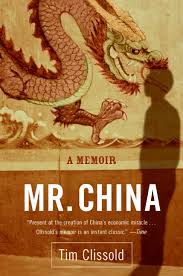
"Mr. China: A Memoir" by Tim Clissold


This one was reccomended to me by a fellow expat colleague back in 2008; finally got around to it, and it's a real gem. Before I go on about how the difference between East and West can cause problems, confusion, misunderstanding, (as well as wonder, fascination and reflection) I'll come right out and say it now:is a cliché. I know. But it is critical to understanding why certain things happen.

Put it this way, were it not for 'misunderstandings' Tim Clissold would be at the helm of a massive empire in China right now, and this book wouldn't exist. Everything they'd dreamed of and planned bumped up against this pervasive, ancient, unshakeable culture. This book is about their attempt to go ahead with their plans and how it all turns out.

This story is about a foreigner, who, like hundreds of thousands who followed him, had a fascination for the exotic, mysterious, richness of Chinese culture, and did everything he could to get 'over there.'

What usually starts off as flirting (traveling around for a week or two, hitting the Great Wall, picking up a book on learning/writing Chinese) turns to full on dating (move to China, get a cool job) and aspirations for a shared future (confidence in culturally and linguistically maneuvering throughout the cities and countysides, with the intent to settle down for good).

Our hero, Tim Clissold, is relentless in his desire to get into China and do something huge. He explains how he got a few lucky breaks, but did what it took to get money ( and lots of it) into China long before anyone on CNN was talking about it. He got in early, which meant, as a trailblazer, he had to be the real liason between East and West. We get firsthand insights on the big bosses in the developing Chinese economy. Just fascinating stuff.

The book turns into a series of Anecdotes about ways in which he dealt with 'the Chinese mind' by way of a handful of clever, tough, and sneaky Factory Managers, as well as navigating the Chinese political structure to not get fleeced in the Middle Kingdom.

I'll admit, the symbolism on the front cover (with a classic Chinese dragon 'biting' a mans head) is a little ominous. "Did he lose his shirt?" "Did he turn to bribes/backdoor deals?" It turns out that neither of these were really true. But his team of investors didn't 'take over' China at all. Not by a long shot.

What you will absolutely adore about this book, besides Tim's astute insight into not only the language and culture "challenges" but his 'case studies' are priceless. Somewhat unbelievable, almost always hilarious, he goes down the list of amazing stories of his mixed bag of Chinese investments. In many cases, the way his Chinese partners attempted to 'get the best of him' was very clever, and the followup is even better.

Come to think of it, the Dragon symbolism is befitting: by the end of it, the dragon doesn't bite his head clean off, it just takes a chunk out of his ego. I think they call that wisdom.

Saturday, February 20, 2010

Think Week

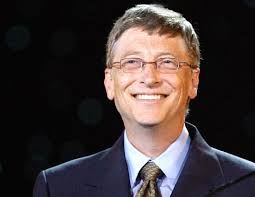
If you haven't heard of Bill Gates' Biannual Think Weeks, this is going to sound pretty crazy: he actually takes off, unplugs, and hides in a cottage twice a year to read books.

I know what you're thinking "Read books? That's so...old fashioned."

Yeah, he's done it for years (well, since he was able to afford a cottage in the hills). It used to be that he would read lots of weird books (really geeky stuff) on Computer Programming, and Financial Instruments, and Business Models, etc. These days, he reads an insane amount of stuff that all comes internally from Microsoft.

Managers at the software giant have 'homework' to hand in to Gates, who spends a week in silence, sipping Orange soda and making notes.

To me, the idea of this guy, worth about 60 billion, trudging up to some remote cottage to 'mark papers' from his employees of 'average intelligence' is just hilarious, and at the same time, inspiring. Even now, he still feels he has a tremendous amount to learn and still strives to be the smartest guy in the room.

So alas, there I was, pondering what to do with my Chinese New Year 'holiday.' I could go to Thailand or Japan, or Sanya, etc. All places which would be expensive/packed for the holiday, and I wouldn't be able to check emails if I was having too much fun, etc. Then it dawned on me... where can I go, where I'll have peace and quiet, and can actually do something productive, ala Gates?

If I stay at the apartment, its way too noisy, and I'll get sidetracked with Internet, Movies, Friends etc.

I actually found a middle ground: I got a hotelroom on the outskirts of Shanghai. A nice one, with internet on the first floor, and room service, out in the far west (near the airport). Minimal disruption, minimal fireworks (99% of the time), and I took a bunch of books.

And you know what? I can probably get away with doing it twice a year. Like I said, I can check emails daily, in the morning, survive off room service, and the amount of time I have devoted to just reading great books (preferably about your line of work, keeping up with the very latest trends in your job, or big picture stuff, like Gates) can be of huge benefit to your company.

One thing I will say, the amount of 'Wow' great ideas I've gotten from this week is astounding. That's how the brain words, you fill it up with 'information' and then it digests it over the course of a few days. It'll rattle around up there, and suddenly BAM, you get the answer to something that was puzzling you (about business strategy, about time management, or about how to get financing on the next big project).

Think about it... you could worse than emulating one of the richest (and smartest) guys alive.

Friday, February 19, 2010

"Synchronicity: An Acausal Connecting Principle" by Carl Jung

What is an amazing coincidence? Is it magic? Is it just impossible luck? Maybe its nothing more than a roll of the dice that the you wake up one day, and you have the flu. As a result you don't go into work, and a few hours later there's a huge snowstorm, and the afternoon rush hour roads are jammed and your colleagues don't get home until 10PM that night. In such a case, you feel blessed to have gotten the flu. But was it just a coincidence, or, was it written, somehow?

One could theorize the weather and your sickness were related. But sometimes, just sometimes, there cannot be any connection whatsoever, and the only two 'explanations' are that you've witnessed a) an amazing coincidence or b) a miracle.


I've wanted to read this book for a number of years; I've been a huge fan of Jung's work since I started reading his amazing insights into personality development (Id, ego, projection, etc). Synchronicity goes beyond those 'theories' of psychology and borders on the paranormal.

Synchronicity, I assumed, was his theory to explain the occurrence of unbelievable 'magical' circumstances, and perhaps, what they can tell us about ourselves. Be warned: although this is only a 120 pager, this was academic piece from a brilliant man, written in 1960. In other words, put the coffee on.

Having read it, I can't believe where Jung went with this idea. Having first introduced the notion of causality and 'connected events' he posits that in such a complex world, it would be easier to start by looking for events that are unique-- they are indeed rare. Connected events are everywhere. He delves into rigorous statistical analysis of card games and dice games, and concludes that ESP may be possible, as well as 'willed outcomes' (Think, The Secret).

This is where Jung gets going. He puts away the calculator for a second and turns to.... Chinese Philosophy?

Having first pondered the possibility of ESP/Psychics/psycho-kinetics, he then discusses several ancient systems of divination, preferring the Chinese (Like the 'Yi Ching') for their holistic approach (again, almost everything is connected). He goes into a very spaced out and esoteric trip consisting of galactic forces (in attempt to prove or disprove Easter and Western Astrological forecasts) and Greek Gods--seriously--knowing that all these things are man's 'creation', the common link is, Archetypes?

Archetypes are an idea of patterns, figures and characters that are common throughout the world's cultures and eras. These seem to be models for possible personalities and relationships which are so universal as to be, perhaps, wired in our DNA to understand (eg. The Hero, the Trickster, the Nurturing Mother--these are ingrained ideas which Jung believes compose our dreams).

This is really an amazing book whereupon, Jung attempts to sit down and prove the power of our minds to either predict the future or create it. I won't spoil the end, because I won't do it justice, obviously, but I'll share an anecdote, which occurred just after I finished reading the book.

It just so happened that during my Think Week, I'd finished a book called 'The Ascent of Money"the day before. Now, there's a part in that book which mentions Mary Poppins: apparently, there's a scene in Mary Poppins where everyone wants to take their money out of the bank at the same time, causing a run on the bank's money. Why do I mention it? Because just before going to sleep that night, and I was watching some TV (keep in mind, this is China, most of the Channels are Chinese talk shows and dramas). I stopped on what looked like a very old movie, with some old-looking white people. It was Mary Poppins.

Why is that weird?

Well first of all its about 50 years old. Secondly, its geared towards a North American audience, making it less liklely to have any appeal whatsoever in China in 2010. The fact that I remembered 'Oh yeah, I was just reading about this yesterday' was amazing. And I'd actually bought that book 'The Ascent of Money' about 6 months prior and never got around to reading it until then. It's amazing that I just so happened to get the book, and then let it sit on my coffee table for half a year before, in the right hotel, on the right week, watching the right channel at the right time, Mary Poppins shows up. And it would have been completely meaningless unless I'd read Ascent of Money they day before, instead of the day after.
You're right, I'm probably just grasping at straws there. Or maybe Synchronicity is just a matter of paying attention to the millions of coincidences and miracles that happen every single day.

Thursday, February 18, 2010

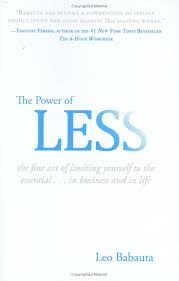
"The Power of Less" by Leo Babauta


I'd already been interested in the a more simplified Zen lifestyle (I've been meditating daily for a couple years now) and picked up this book because the title was so representative of my direction recently: less stress, less hassle, stop messing around and focus on the things and people that are really important to me.

This book is not just a 'guide' for doing less; it seeks to bust what I call the Multitasking Myth: that is, it emphasizes that by doing 14 things at once (MSN, Emails, Music, Twitter, Sending Text messages, Eating...etc) you're actually way less efficient. You're way more stimulated but way less productive.

(Note: there has actually been a bit of talk on 'Multitasking' recently on the web with the recent launch of the Apple iPad, which, unlike a real computer, is generally designed to run just one program at the same time. Techies screeched, "How can you get anything done without Multitasking?"... Ironically, it might be a great built in 'feature')

In this sense, at its core, the message is to 'unitask'. Focus on the task at hand, and finish it. In the same vein as Tim Ferris (http://www.fourhourworkweek.com/blog), Babauta is a big fan of batch processing things. Everything from Email to Errands, Bill Paying etc. And it struck me that its actually a very popular idea: just ask Henry Ford.

We've known the power of specialization of labour for so long, so... why are we so hung up on the idea (rather, the myth) of doing a bunch of different things at once? The truth is, to really hit your productivity groove, you gotta turn off the music, get off Facebook, and focus. The productivitity gains are amazing. I know, I know, the great thing about Multitasking is the flexibility, and the time-saving that comes from driving while you play with the your Blackberry, yada yada yada. Come on, what kind of brilliant writing have you done halfway through a Big Mac? Be honest.

Ok so that was just one element of the book, but I think it exemplifies what we're trying to do here, 'Power of Less' doesn't mean you're doing less, you'll actually do a ton of things, the point is less distraction and less wasted energy on things that, frankly, don't really mean much in the long run.

A big section of the book, Babauta talks about nailing 6 month to multiyear goals by breaking them down and, again, focusing on just a few goals concurrently (you could do just 1, ideally, but there are often time gaps between certain objectives, and we don't want to waste that time idly.)

If you find yourself getting sidetracked easily at work, (it's normal, we all do) definitely check this book out (as well as the aforementioned Tim Ferris classic, 4 hour Work week).

Follow this author on Twitter@zen_habits

Node Zero: "Love is the Killer App" by Tim Sanders


For my first review, I want to go back to the first book that sparked me to get into business. It was early 2000's, and I was working like a dog. At a factory. While I figured out what I was going to do with my life. Everyday after work, I'd get home and eat in front of the TV. Usually around 3 or 4 in the afternoon, there would be some 'Biography' or 'Inside the Actor's Studio' on, and I was always really into those, hearing about brilliant people, and their humble beginnings.

It was around this time that I saw the story of Bill Gates and how Richard Branson started his empire when he was 16, etc. I was buzzing off these 'interview' shows, and there was something about them that really turned me on, I wasn't sure what it was, but each one had a nugget of genius, and I felt that if I could just keep getting the odd nugget of genius, maybe I could find what I wanted to do with my own life.

Flipping the channels one such afternoon, I stopped on a local access show because there was this wild looking hipster guy, with purple tinted shades passionately talking up a new way of doing business. I listened with rapt attention, as this guy, Tim Sanders, tore apart every negative stereotype about the big bad world of business.

"These sharks don't last"..."No one wants to be that cheesy guy at the Office"..."I love my Company"..."The people I work with are rockstars!"

Before I even knew what company he worked for (Yahoo!) and what his 'job title' was (Chief Solutions Officer) I knew I had a lot to learn from this guy. He was living the existence I'd always dreamed of, basically he was a Businessman with a Conscience. No, scratch that. He was a Passionate Businessman! And he wasn't just scraping by, he had landed a huge role at a huge company that had their pick of pretty much anyone for that job. In other words, his 'passion' wasn't a fluke, his conscience, his authenticity was a core element of how he did his job! It was the thing that set him apart from everyone else! At the time, it was a real revelation to me that being anything other than a slimy salesman could be an... advantage in the workplace.

He'd written all his ideas down in a new book, and within days I was delving into "Love is the Killer App: How to Win Business and Influence Friends." Tim breaks down his holy trinity of Bizlove: Knowledge, Networks and Compassion. This was so huge to me then, and now, looking back, it's still a rarity to find people who act the way this guy lives.

The idea goes something like this: you can actually have really close relationships with great people in the office, it doesn't have to be cold, and it doesn't have to be cheesy and fake, but you have to have to know you're stuff first. And for that, you have to hit the books, and you have to become a social animal, networking the right way.

In order, reading great books, applying their knowledge, sharing it freely with your growing network, and then, when you have demonstrated to people that you know your stuff, then you can start building sincere relationships with people. If you do that, you'll almost never lose a sale, you'll almost never be undercut by a competitor, because it won't be about dollars and cents, it'll be a sincere partnership, in a sea of Machiavellis.

If you don't know anything, and start making promises to the customer (eg. all your prospects) and then let them down, you are the cheesy guy. You're the shark.

At the end of this great book is a killer Reading list to get the newly indoctrinated on their way, not only Business books, but books on Tech, books on Out of the box thinking, and books on ...Love.

I couldn't recommend this book more highly, and if it isn't already obvious, Tim Sanders' ideas are what led me to eventually studying Business in school, and even doing this very blog. Tim Sanders, among other things, is the anti-Cynic, and I believe, that should be enough to get you to pick up his book. Once you get a few pages in, you'll be hooked.

Follow this author on Twitter@sanderssays

Saturday, October 17, 2009

Wednesday, October 18, 2006

Doing Mushrooms and the Art of Feeling Important

Phew. That long of a break eh?

So first the mushrooms bit. No I didn't do mushrooms last week. No I didn't drop acid. And I didn't discover the meaning of life.

Now that we got that out of the way, I have been doing the grad school thing. Is it hard? A litte. We are required to have 7 or 8 'projects' ongoing continuously. My strategy has been, I should be chipping away at all of these every night, so I never have to cram or force something.

Interestingly, there is much less emphasis on tests (which we have) and midterms (which we also have) but projects. We are always doing presentations and projects. I've said this before and I'll say it again: get good at talking and thinking on your feet. Whether it means joinging the debating team or just some minimal involvement in student politics, whatever you do, it will benefit you greatly in grad school. A lot of students who don't have that are really stressing out and wasting energy at the last minute and I'm just ..... chilling. What's going through my mind? I know things will be okay. I also know that the worst thing I could do is freak out and ruin what I've built up so far.

At any rate... after all this school you do.. and all these tests.. and all these GPA points youv'e fretted over, what do they tell you? "It's not about being smart. It's about networking." So on top of the school stuff, they come right out and say, "Oh yeah, and...make sure you're funny, interesting and charming, or you won't go anywhere.."

Not that I'm scared, but it's kind of funny.

Doing mushrooms. I do want to mention something about that. I've been to all these networking events, sometimes they're really far away, in some town I've never been. Have you ever been somewhere new and felt... a strange sense of peace? Last week I went to a former prof's house to discuss a project about Future Studies. Her house was way out in Anmore, which is basically a half an hour north of SFU, which is... out there. Being somewhere that seems so disconnected from your 'routine' life seems to give you perspective, which is exactly what mushrooms do.

Anyway, I hope that, if Anmore gives me the chills, Beijing will give me convulsions. ;)

More later, this is starting to get fun. I definitely feel great about this program :)

Monday, September 04, 2006

Food is good. China playing nice is even better.

One of the keys to development in the US, back in the 1900s was greed. Is that it? Greed? The westward expansion of the US acted like a saftey valve; if things got too populated, or too busy, or too conflicted in the ports, people could expand westward. The prospect of land, and natural resources (ahem) and gold made the Western Founders the risk-takers and entrepreneurs.

In China, it's not that easy. They have this big desert to contend with. Actually there has been serious neglect of the Chinese farmers, which, sounds inconceivable considering the importance of food, with such a massive population.

The density of population here in Canada makes the Chinese situation a little hard to imagine. 'Why would people live in the desert?' Here in Canada we tend to revolve around major metropolitan cities. The trend is clear. In China, you have masses of disconnected, uneducated people in the rural countryside. Finally the government's doing something about it. Admittedly, this is a great thing, and we'll watch how things shift over the coming years. Here in Canada, we must not take what we have for granted: education is paid by tax dollars, health care paid by tax dollars, and even the bare minumum needs are met by tax dollars (i'm referring to different iterations of the welfare system). The Chinese should be so lucky.

China has focused on developing its industries and cities in the past 20-plus years. Sluggish rural development provides a stark contrast to booming urban economy.

China set the goal of building new countryside last year, hoping to achieve balanced development in the country.


Todays announcement is not really about education, but incentive. The growth and expansion of the US in the gold rush was about greed and incentive--something sorely lacking under a totalitarian Communist government.

You can read more here about the land rights issue, which comes down to incentives. In economics we talk about internalizing the benefits and costs. The motivation comes from an internalized benefit, which in this case, is profit sharing. Good stuff.

In other news, 40% of Chinese don't speak Mandarin. Hmmm.. Did I read that correctly? I guess that speaks to the importance of Cantonese and other dialects; we've all heard (or experienced) the difficulty of learning to read and write Chinese. Remember that 40% number when someone questions China's 'developing country' status. It's not just about money, but GDP per Capita, Health Standards and Literacy Rates. Those three things are what make up the Human Development Index, and are richly interlinked (ie, increases in one assist the other two).

Wednesday, August 30, 2006

School... More School? This is too fun.

No way. Done with memorizing charts and stats and lists..

I'm starting to LOVE where I've decided to spend the next 2 years.

The McRae program is an International Business training program ... Involving extensive networking, language and cultural skills---on top of the all the.. you know.. business stuff (marketing, finance, economics, politics, current events).

This week has been INSANE.... The orientation has been incredibly fun, I met my classmates (about 30 kids ranging from 22-34 yrs old) from all over the WORLD: Brazil, France, USA, China, South America and on and on...)

So far it's been shmoozing, as well as tons of team-building games: incredibly fun! From minute one we were goofing around and getting to know each other--I can tell it's going to be an incredibly tight group :) !

Today was a BLAST. The itinerary said "Personality Testing".... Some people may not buy into any of this stuff, but the results were pretty startling. They put us through a mini-test to find what kind of personality we were (Planners, Analysts, Group Work, Risk Takers) and had us talk about how we think and 'offended' we are by the other groups. ;)... Sounds cheesy, but really, the people who were grouped together had INCREDIBLE rapport considering we only met 2 days ago... we all thought the same way, quite eery. Me? An analyst. Sometimes I take forever to make a decision, and I'm a bit of a perfectionist (ugh, that's sometimes a pain in the ass) but I'm very curious and love to find out about new parts of the world, and new things etc.

Anyway, the other part of the day was taken up by Language Testing and Networking Workshops.

I love learning Chinese so much. It's such a simple, fun language to learn, and despite the fact that I hear it like everyday, I hardly ever speak it. It was cool to 'be forced' to speak Chinese today and actually be able to (ahem) converse with the Mandarin Prof. The other guys in the group are pretty amazing.. a few of them had lived in Taiwan for 4 years so... it's really inspirational to see their level. And yes, they all know about ChinesePod.

On top of all this school stuff which is wild and a little unreal... I have a wedding (gulp, not mine... my brother Ian) to 'worry' about in the next couple weeks. So much drama. I am going to stop working so much to do all the stuff i WANT to do (stag party...stag party...stag party).

Oh. And I'm going to take up golf too. Hawt.

Friday, August 18, 2006

China and N. Korea

Alright, this is something that came up some time last week. I've been busy, but this is actually very big news.

All this stuff we keep hearing about North Korea and China is scary. They share a common thread with Communism. Does that mean that no matter what, China will still back North Korea? That has always been the fear.


Vice Premier Hui Liangyu visited Pyongyang to celebrate a 45-year-old friendship pact with North Korea, and to coax the isolated totalitarian state back to disarmament talks after its July 5 barrage of missile tests alarmed Western capitals.


But China's failure to sway North Korea and its weekend vote for the U.N. resolution condemning the missile tests exposed frustrations behind China's public vows of friendship, and raised the price Chinese President Hu Jintao may pay as he seeks to somehow both comfort and cajole Pyongyang.


In January, North Korea leader Kim Jong-Il made a nine-day visit to China. Hu hosted Kim several times, proudly showing him oversized vegetables at an agriculture institute.


Speaking of cucumbers...


China believes an endangered and resentful fortress state on its doorstep could threaten its security, and waves of refugees from a North Korean collapse could destabilize its northeast.

While few Beijing analysts doubt China must engage its struggling Stalinist neighbor, some are now wondering whether Hu's embrace of Kim may have emboldened Pyongyang.

"It's been very easy to create misunderstandings, because it created the impression that China cannot abandon them," said Shi Yinhong, an international security expert at the People's University of China in Beijing.

"It's been very easy to create misunderstandings, because it created the impression that China cannot abandon them," said Shi Yinhong, an international security expert at the People's University of China in Beijing.


Some officials in Washington had hoped the crisis would drive Beijing to coerce Pyongyang, but Chinese analysts say it has in fact illustrated the diminished leverage China has since bowing to Washington over its financial sanctions on North Korea.

Pyongyang is bitter at Beijing's acceptance of U.S. sanctions on a bank in Macau -- the gambling enclave that is Chinese territory -- after the bank was accused of acting as a conduit for North Korea's criminal earnings, said Shi.

"That's cut Chinese leverage over North Korea," Shi said.


Um, so China getting less crazy, North Korea getting more crazy? D'oh..


The deepening impasse over North Korea may ripple across China's broader international standing.


China's has used its hosting of six-party talks aimed at ending North Korea's nuclear ambitions to burnish its image as a "mature and responsible global actor", said Andrew Scobell, a specialist on China and North Korea at the U.S. Army War College.

South Korea, the United States, Japan and Russia also take part in those discussions, which have stalled since late last year over North Korean objections to the financial sanctions.

"If the six-party talks collapse that would be a major setback," said Scobell, who stressed he was offering his personal views. "The talks have given China a chance to project an image as a global statesman."

China will now be weighing what combination of promises and pressure may induce North Korea to desist from further missile launches and return to talks, said analysts.

South Korea has already announced a suspension of aid, making China's economic lifeline to North Korea all the more crucial.

Trade between North Korea and China reached US$1.58 billion in 2005, an increase of 14 percent on the previous year, according to South Korea's Trade-Investment Promotion Agency.

Beijing may consider a "temporary limited, unpublicized" squeeze on the flow of trade, aid and oil to pressure Pyongyang, said Shi.

But the Chinese Communist leadership's entrenched interest in North Korea's survival mean it will probably reach for rewards, not punishments, to lure Pyongyang back to talks, said analysts.

"North Korea never does anything without demanding something in return," said Scobell. "The Chinese are going to have to pony up something significant to get them back to the table."


Saturday, August 12, 2006

Next Season of 24... The Chinese are back

Alright, so my favorite show on TV (now that the Apprentice is kinda over, and the Sopranos last season was limp) is coming back for season 6, starting in late August.

As we know Jack got abducted by the Chinese at the end of the last season and is on a torture chamber on a Chinese ship in the middle of the Pacific Ocean. Can't wait to see more of Jack. Here's a quote from Sutherland himself,

Kiefer Sutherland revealed Sunday in an interview with a British newspaper that expect the sixth season of "24" to be more an inward journey.

"We've had five years of him saving a large thing. This one's much more about him saving his own ass. He'll go from being the one who hunts people down to the one who's being hunted, so that in itself turns the show around" says Sutherland.


The last season was pretty amazing, partly because of the 'life imitating art' spookiness of the US middle east crisis. Um, thanks Bush?...


Okay, enough of that, since we're on a China+Pop Culture bent, how about the NBA? David Stern recently said he was excited that 1 in 4 NBA players are from countries outside of the US, and China is actually their Number 1 priority these days. Last time I checked 1.2 billion is indeed a big number, but realistically it's still a 'growth' market. The good news is that China is getting special treatment--they'll be getting their NBA games again:

Regular season NBA games could take place in China as early as next year, league commissioner David Stern said on Sunday.

The last time the NBA came to China was in October 2004 when the Houston Rockets, led by local hero Yao Ming, played pre-season games against the Sacramento Kings in Shanghai and Beijing.

"We didn't have the China game in the following year in 2005 because we were having a collective bargain then," Stern told state news agency Xinhua in Guangzhou.

"We don't have it this year because of the preparation of the world championship.

"But we are planning to play some games next year here. It could be pre-season, or even regular season."


David Stern has been doing some wacky things over the years, even muttering something about an International Basketball League, so anything that brings the NBA and China closer together is a good thing.

Okay, so we know all the best NBA players (sorry Kobe) come from dire circumstances--is China the new ghetto hotspot for NBA talent?

Why not ask this guy?

Apologies for the cheesy music.

Sunday, August 06, 2006

Sunday Morning Muse

This is what I was thinking about when I woke up this morning. Groggy from a noisy, blurry Saturday night.. I can scarcely get a grip on what I'm thinking about, so I'm writing it down.

Is there ANYTHING about you that you'd like to change? You're too skinny/fat/shy/obnoxious.. maybe you've been trying to start something, learn a hobby/skill, become a better friend or a better boyfriend/girlfriend.

The point is, if there's ANYTHING about yourself you've written off as a personality flaw, etc, you can change it. You can be ANYONE you want.

And if you think about it, it's great that we all have flaws. We are all endowed with flaws at birth, character flaws or physical limitations, this is a CHALLENGE, and thank goodness we all have challenges or life would be BORING.

Imagine a movie with no conflict. Yeah. That boring.

So what do most people do?

They look at successful people and copy the EFFECTS OF SUCCESS.

Interesting, they see someone like a famous actor or high paid executive and try to be him by copying the things AROUND him. It's a big lie, like, "If I can dress like him and look like him and drive the same car, and get a hot girlfriend, EVERYONE WILL CONFUSE THE TWO OF US"

The problem is that YOU'LL know the difference. And you'll be empty. And the other guy will still be excited to get up every morning and do what he does, be it acting, his business, or his political agenda or whatever.

But there IS value in imitation. So now I'm a hypocrite. ;)

In my mind, it's pretty great that "successful" people are highly visible. It's like a public good. As soon as a celebrity hits the 'big time' they are in books, magazines, and on TV. You have the internet at your fingertips right now and can search for ANYONE in the world who is 'famous.'

From now on, these people are going to be our models for a successful 'career.' We're going to imitate them like crazy. For other things in your life, you can model as well and INTEGRATE certain behaviour into your life. So if it isnt the stuff AROUND them, what are these people doing that you're not.

Making different decisions. Sorry if that sounds like a non-answer, but that's it. Getting the clothes or the car will NOT work, that's the EASY PART. You have to start making DECISIONS like a successful man/woman/actor/journalist.

What do most people do? They try to come up with a logical reason for every move they make, analysing their problem to death and trying to come with with the 'solution.' They call it 'soul searching.'

This brings me to the next step.

Stop thinking. Stop Soul Searching. Stop waiting for a day when being healthy/charming/diligent will make sense. It will make sense after you've done it. That's why you have to force yourself to do it.

There's probably ONE part of your mind that isn't doing you any good. The cliché would be a doorman at a hotel. The friendliest guy in the world. Very nice and talkative, good looking guy, but just can't figure out how to take his doorman job and go UP the ladder. There is no ladder. How can he expand his circle of influence and see career growth?

Just like you, that doorman has what I like to call a 'mad scientist' in his head. We all have it. A mad scientist in our head in charge of SOME aspect of our lives. He's very good at coming up with graphs, tables, logical formulae. But he's C-R-A-Z-Y ! You should not listen to a word he says. He's not gonna build a time machine, crack cold fusion or discover the elixir to eternal life. And he's NOT going to help you lose weight/get a raise/meet new friends. He's not. He's crazy. He hasn't been out of the house in YEARS. You shouldn't listen to a damn thing he says.

So combining these two ideas we have a model for HUGE success:


1.Successful people tend to be highly visible. This is a library for success. Pick anyone on earth, find their biographies. You can model them by copying their ACTIONS. Don't bother trying to think like them yet, you're not there yet.

2.Block out the logical part of your brain that has been trying to solve this problem for 10 years. Haven't you given the mad scientist enough time to prove himself/herself?? The mad scientist is crazy, and should be ignored. It'll be tough at first, but over time, you won't hear him/her.


Lastly, to vanquish any further doubts (ahem, mad scientist?)remember that NONE of the important things are UNSOLVABLE. The real challenge in your life is THIS. Whatever it is, you're probably confronted with it on a daily basis. You've probably thought it's 'not fair' that you've got this one thing that no one else has to deal with.

Be thankful that you have a challenge, your movie has a conflict. You should be ecstatic! But when you solve this problem, you will run into another problem, and after that there will be another problem.

THIS IS A GOOD THING!

The point is not to have 'zero problems' but to have better problems (credit Tony Robbins)...

Imagine the day when you're getting home from work, your loving family is at a restaurant and they call you to tell where they are. As you're talking on the phone in the car, you're a little distracted and hit the car in front of you. Nothing serious, but you are going to have to pay it out. These are the moments when you're going to be angry IN THE MOMENT and think to yourself "Why me!? Why does this stuff happen to me?"

Stop.

In moments like this, the mind blocks out the past, the future and childishly and selfishly focuses on the moment. You're on the way to share a dinner with your family that loves you. That's a pretty nice problem to have. The hundred bucks you're paying out for the car would NOT have made you happier, so you really have nothing to be mad about. Allow yourself to be happy.

You will never be free of problems as you grow more and more, but THATS A GOOD THING. Or else you would have a boring movie.

;)

Long post. Phew.

Wednesday, August 02, 2006

Booming in China, but out of control?

Tsk tsk tsk.. I find it hard to believe something so big and slow is all of a sudden 'out of control'

But apparently it is.

The Chinese Economy is doing very well, remember Taiwan was at 10% growth for about 40 straight years. I don't think China at 8% is that scary (ahem, though the country is about 30 times bigger by population.. not usually a great sign for GDP/capita)

Because I'm not living there, I can root for all the really great things that are happening there:

The Olympics in 2008 mean TONS of construction, and all the new infrastructure is investment based largely on that.

In Beijing, an airport terminal under construction will be bigger than all five terminals at London's Heathrow Airport combined. The capital will also add an estimated one billion square feet of high-end property by 2008, according to Jack Rodman, a partner at Ernst & Young in Beijing.


Cool. But let's not forget, China has been hauling ass to catch up to Hong Kong. Which means new laws bringing them closer to the, eh, 20th century. They're still stuck in A Tale of Two Cities, in terms of their working conditions, but be patient. It's called gradualism.

And what has the US been saying all this time? The US is sick of how.. er.. competitive CHina is, and would love it if their yuan was more expensive.

In other words, "please let the Yuan float because it will hurt you" Which China can now do. Yay!

Does it sound like they're freefalling in an Economic boom?

China has tried a variety of tactics to rein in the economy. Under pressure from the US, officials a year ago loosened the yuan's peg to the US dollar, and the Chinese currency has since appreciated about 3.8 per cent. The People's Bank of China has raised both interest rates and reserve requirements for banks, and last month ordered regional branches to halt "blind expansion and building of redundant, low value-added industries".


They call it gradualism.

At least they're not taking 'advice' from their competitors.

Tuesday, August 01, 2006

The Paradox of Mastery

Busy busy busy....

Last couple weeks up at SFU, and I gotta tell ya, it's getting slack. I've got a few presentations to do (old hat by now) and about 500 pages to read, most of which I'll fake my way through anyway.

The other day I was in the library, killing t-- er, reading up my schoolwork, when a thought occurred to me.

As I watched herds of stressed out students cram for Finals, or finish some online chemistry assignments, I thought what was really motivating me (clearly, it was a case of lacking motivation ;) )..


Most students do the University thing for money. I'm so thankful that I actually do get jacked up talking about international relations and economics, and I don't doubt that every Chemistry student or Humanities nut out there will say the same thing.

But ripping our hair out to be 95% kids in some subject....? Now, if we could use Chemistry to come up with some useful new drugs, yeah, that's incredible, and the Humanities guys are salivating at the thought of travelling the world doing excavations (I won't lie... I'm thinking Indiana Jones right now...I took a couple HUM courses.. very very cool stuff).

Are there other things we freak out about, but don't really do us any good?

I thought about our obsession with Mastery, more specifically. When I think about playing a sport, or playing music, I think about Mastery. Weird huh? When you take a course, you probably think about passing, but there are A LOT of kids that think about MASTERING a particular subject.

How about being the best Doctor, ...not just the best doctor you can be, but the best doctor THERE IS?

We think about perfection when we go to the gym... when we check ourselves in the mirror... when we check our bank accounts... After all, anything less than 'perfection' is a flaw...

So what IS the Paradox?

Trying to master something that inheretly doesn't bring you satisfaction... and when you DON'T get satisfied, your response is to just try harder.

Wow. Sweet. Vicious Cycle.

Imagine you work in a lumber yard. I did this one summer, carrying lumber all day... At first I was clumsy, but I made a game of it, getting better at carrying the wood in bigger bundles, getting good a wrapping the whole thing (some tarps that went over the wood) and stapling the tarps, faster and faster... so that it was like a race, who could get their bundle done fastest.

That's the only way to motivate yourself in a job like that---- the male ego. At some point, you don't make any mistakes.. but something has to give, because it's not a satisfying job... you can either get BETTER and hope that THAT will put a smile on your face, or change directions...

What ultimately brought me satisfaction was the people I worked with, matering the job was like a hobby, a distraction.

My point is not that there are things out there that you shouldn't stress out about, but hey, there are things out there, that get ADDICTIVE because they are inherenty UNSATISFYING... It's hilarious how popular these things are..(duh, they're addictive... smoking, drugs,gambling, crappy movies, video games, shopping addictively, chasing fame, popularity, getting a great looking body, getting someone to like you, a great looking bank account... it's like a sugar rush)

Do you have anything like this in your life...? Is it time you decide what actually makes you happy, and establish some RULES for handling all these distractions?

I have to be VERY CAREFUL when I look at my own life, and say, "Okay, besides the money and power thing, where am I going" because if it's something shallow like that, I know it'll lead to ruin..... Fame, Money, Power, these are EFFECTS of being thrilled/ecstatic NOT CAUSES.

I'd love to hear back from some of you guys, we'll see how this things holds up, and I'll let you know what happens with BCbookworm.com....

Have a great Sunday!