Monday, May 31, 2010

"Good to Great" by Jim Collins

This book came out almost 10 years ago, but within its pages, are some of the most thought provoking results on Business Excellence. Actually, Excellence in general. The great thing about studying Public Companies is that we can study their freely available numbers, we can break down their acceleration of growth, and we can talk to their bosses and innovators.

And that's exactly what Jim Collins and his team of researchers did. They found a handful of companies that had huge sustained growth for 15 years and asked "What are they doing? How did they get here? Why are they so rare?"

What they found were a string of totally non-MBA answers. A few simple concepts and only 10 or 20 leaders in the country could hold themselves to. Wow.

First, the leaders: we know that leaders in business can be very loud, very cool, very power hungry and egotistic.But these types of characters were nowhere to be found in the study. What did the leaders of these great companies (like Nucor, Gillette, Wells Fargo) have in common, when it came to leadership?

Diligence, and Modesty. That's it.

If you can find a guy or girl who will work all day and all night, and will do whatever it takes to rigorously do the homework (on the competition, on new technology, when it comes to hiring, when it comes to expansion), who is modest to a fault, that's your future CEO.

And they discovered something remarkable about their compensation too: it doesn't make a difference.
All the nonsense and backdoor deals going on on Wall Street, and here's a group of the best companies in the last 15 years, according to Wall Street, and the compensation was not a motivating factor, and did not move the stock price up or down. So what was it then?

These old fashioned, hard working, modest guys just wanted their company (not themselves) to grow and be great. Part of that modesty the leaders were not going for glory but diligently, and rigorously, doing the hard things to promote the company, the group, the collective. And here's a crazy thought: if you really want your company to be great, you'll set it up so that it will continue to be great, even after you retire! How many retired CEO's do you know that lose sleep thinking about their old company?How many companies have you worked for, that you've worried about, long after you'd already left the job? That's real passion, loyalty, and care for the company. And it's rare.

There's another theme that really hit home for me, on a professional level and a personal level. They call it the Hedgehog concept based on an old parable of the Hedgehog: 


In the woods, the Fox is always trying to eat the Hedgehog, but never succeeds. He tries various tricks, pouncing in the day, pouncing at night, being slow, being fast, luring the Hedgehog, or a surprise attack, but he just fails and fails and fails. The Hedgehog, with none of the speed, agility, or aggression of the Fox, survives with one simple defense. Whenever it sees the Fox coming, it just rolls up into a ball with those spikes out. The Fox can do nothing when the spikes are out, so it eventually gives up and wanders off. The Fox goes hungry and the Hedgehog thrives.

How could such an weird looking creature be the basis for business and personal excellence? By sticking to one thing. Basically, the Fox can be compared to a company with tons of great technology, a bunch of different projects, and lots of resources. By bouncing around to different things, it never really focuses its energy on one thing. And why does that matter? Because it never gets to be the best in the world at one thing that way. And so you never hear about them.

As people, we can consider the Hedgehog an inspirational figure of sorts: it is born with this one talent, or trick. It exploits that talent every single day, and as a result it thrives. It doesn't aspire to be like the Fox in speed and agility, and even grace. It just plods along, and slowly but surely, becomes great at being...a Hedgehog. Think of a Comedian that works on this one set of jokes, for 15 years. For 15 years you never hear about the guy, and then suddenly, BOOM, he's everywhere. You start seeing clips on Youtube, you hear he has a new TV show and movie deal in the works, and your friend think he's the funniest thing on Earth. Thats how it happens. Not overnight, but a long, gradual, almost mundane process, of sticking to one great thing.

Back to business, we found that this is one of the hardest things for great companies to do: say no to trendy, cool, hot new projects that threaten to pull the company far away from their core excellence.
For example, in the book, the American Pharmacy Wal-Greens decided they wanted to be the most convenient pharmacy in the country. That was it. Once they had that idea, all decisions were easy. It meant doing some crazy things, (like closing a store, only to reopen a store a block away with better access from the main traffic routes, etc) but it got them all the answers. If you can prioritize, you can answer any question. And you can only prioritize if you have rigor and discipline.

The first two factors of the Hedgehog concept are Passion and 'Best in the World Focus.' The third and final factor is, at last, about money. After all, I didn't say these companies were the coolest in the US (a steel company and a drug company?), they were being highlighted because of their consistently excellent performance on the stock market.

The final factor was choosing a metric that defined how they measured excellence, and zeroing in on that target. These guys could aim to maximize profit per store, profit per employee, profit per country, profit per customer visit, anything they wanted. And each one had its own implications for future plans. The bottom line is this, the third factor is the way the company measures how well people are doing their jobs. Walgreens wanted to maximize profit per customer visit. That meant every time someone walked in the door, all the advertisers had done their jobs. Now it was time to see just how great the experience was to be in a Walgreens store. If it was great, profit would trend up. If it was confusing, noisy, over crowded, empty shelves, rude staff, the profit would trend down. It's that simple. By zeroing in on this one metric, Walgreens beat the market by a mile, year after year after year.

There's a ton in here, that I just couldn't get to. If you're into it, go pick it up, its a great read, lots of amazing anecdotes in here. Yes its a business book, and yes I've got some terrific ideas for my own job, but you can get a tremendous amount of personal insight as well. Here's food for thought : what one thing can I do, day in, day out, and eventually be the best in the world at?

Friday, May 21, 2010

"Meeting the Shadow: The Hidden Power of the Dark Side of Human Nature" edited by Connie Zweig and Jeremiah Abrams

After another bout of writing, some to do with Psychology, I was reminded of an incredible book that I should share on here, about peeking into the Shadow. This is really mind cool stuff-- a collection of short essays on the 'Shadow'...not to be read front to back, but nibbled on.

If you're not familiar with the term, "Shadow," Psychologists Sigmund Freud and Carl Jung bandied about terms regarding what they thought made up a Personality, namely, what is the process of Human Personality Development. This is all very obscure stuff to measure, of course (being Psychology), but after 20-30 years of dealing with a vast array of Psychological traumatized patients, and finding patterns, some these two mavericks had a great base of experience to draw from. Even more fascinating, they both made detailed records of their dreams, and analysed the symbols therein (leading to some of Jung's most provocative work on Archetypes). What arose, in one form or another, was a theory of development whereby the Human Personality is said to split into the Persona, and the Shadow. Basically, the whole 'Self' (you and everything about your personality) is split into the Good part (the Persona) and the Bad part (the Shadow).

Before I get attacked for using such childish language here, the "Good" part is not necessarily good; its only good because Society says it's acceptable and polite. The Bad is not necessarily bad at all, except that Society says it's inappropriate or unsuitable for public display. (As you can imagine, this means Shadow and Persona traits likely vary from country to country, and change over time, as society's norms change).

Remember when you were in primary school, and a teacher told you not to speak out or make jokes in class. Maybe you liked to ask very interesting or unique questions in class, and the teacher told you to be a good boy/girl, and only ask 'good' questions. Maybe you told your parents you wanted to learn the electric guitar, and they said you couldn't because they didn't want you to hang out with a 'bad crowd.' When we are very young, we are free of hindrances, brashly expressing ourselves, like little Emperors and Empresses.

"I'm hungry!" "I'm bored!"  "I want candy!"  "I'm not sleepy, I wanna stay up!"

Society eventually nudges us in the "right" direction, by telling us what we should and shouldn't do. This is why we need a Shadow. We need a place to put all those 'bad' character traits.

In terms of Personality development, as soon as we learn certain things are 'bad' and certain things are 'good', we subconsciously remove certain elements of our personalities from 'public display.' That is, we take certain parts of our personality and put them into the 'Shadow.' All the things which society says are 'acceptable' become the Persona. The result? Most of us are civilized men and women, following the rules, waiting for the right traffic light to go, and waiting for the right signal to approach and talk to our fellow man, never acting on impulse, always subconsciously calculating to do the 'right' and most 'polite' thing. Subconscious is the key here. To stay sane, and stay congruently in Society, the Persona must act as if the Shadow doesn't exist.

As it turns out, if we are very 'good' people, much of our 'life energy' is trapped in the Shadow. We are essentially living half of our true personality, and putting half our personality, half our impulses and half our desires, in a prison of sorts.

Sometimes, in the midst of a trauma, a crisis, or an emotional breakdown, the Shadow will 'break out of Jail' and let itself be known. Also, if we ignore it long enough,  eventually it will burst onto the scene, with all its wild impulses and outrageous ideas. After all, if we follow the 'Persona' all our lives, and don't feel happy or fulfilled or loved, eventually the Shadow's nagging whispers will start to make sense! Perhaps not surprisingly, in addition to life energy, much creative energy is locked up in the shadow. After all, whats could be more boring, than a movie, TV show, or song spawned from dozens of intermingling 'acceptable' and Politically Correct traits and feelings.

'Meeting the Shadow' not only outlines much of Carl Jung's ideas (which did differ greatly from Freud, by the way) on the Shadow, it also outlines potential strategies for bringing the Shadow to the for (hence the title). The goal is not to become crazy. The goal is not to go on a wild killing spree. Locked up in the Shadow are very good traits, the problem is Society has given broad generalisations to young impressionable Children who then took it to the extreme.

"Don't Yell"
"Boys don't cry"
"Girls don't talk like that"
"Always wait your turn"
"Be nice to people older than you"

These may be good guidelines for young people, but as rules to live by they are ludicrous. Never Yell? Ever? Is it also a bad thing to get mad? Is it a Sin to ask for something, like food, or attention, or love? Also, if an older person is abusive to you (physically, emotionally, etc) should you let them??

As you can see, as we get older, we absolutely must examine the 'over-simplistic' beliefs  and rules we had as a child. If the Shadow goes ignored, it results in lifeless slugs, dead on the inside, from lack of expression, slaves to their childhood masters. Not only are they unattractive to the opposite sex, they are unattractive employees, and unattractive friends. Those who do not reconnect with the Shadow, ultimately become Zombies, constantly in fear of 'crossing the line' and occasionally snapping in a burst of 'Shadow' fury.

I know what you're thinking. Yes, sometimes these 'bursts' where the Shadow demands to be heard can be dangerous and shocking. It would not be surprising to hear that a normally quiet and subdued man woke up one day, mad at the world, mad that he's done everything 'right' and is still sad, lonely, and wretchedly poor, and suddenly gave into all of his Shadow instincts at once, possible attacking or hurting people in his apartment building or office.

Another fascinating consequence (according to Jung's work) of having an overly 'heavy' Shadow, is that we project those 'bad' traits onto other people. After all, if I'm such a good boy, then the only source of 'rude' and 'selfish' behavior in the world, must be other people, preferably people of my same gender, but from another country, or social class. It's incredibly common to hear ourselves or others make comments like "Everyone from [City X] is a jerk" or "I don't know, I just think people who [play badminton, drink espresso, write blogs] are the scum of the earth," and when we hear that, its the Persona bashing the Shadow. The Persona is saying, I don't like these traits so I've projected them onto people who play badminton, or work on Wall Street. Yes, this has dozens of implications for not only Racism, but also Wars. We have a situation in the US right now where Mexicans are being characterized by some as 'unfairly cheating' and 'trying to take our way of life'. Trying to build walls (or in Arizona's case, a fence ) to keep the Shadow away, is at once hilarious, and deeply sad.

If you can cut the Shadow down to size, and bring more Shadow traits to the fore, you can cut down on this insane Blogger bashing. Anyway, the goal here is not to go crazy and delve into the most bizarre impulses, but to get back that energy, that's locked up in the Shadow. The relaxed, cool, eccentric man understands and is curious about his dark side, and occasionally expresses it through art, or poetry, and is never afraid to stand up, and 'selfishly' ask the questions he's burning to have answered. Moreover, if his house is robbed, or his is physically threatened, he needs to channel his Shadow energy to protect them, not be the good boy.


A basic understanding of the Persona and Shadow complexes (that's what they are, just ideas, not actually real 'areas' of the brain, etc) helps guide us to understanding the Ego--how we can tame it, and how we can harness it. Perhaps I will write more about this in future.

Saturday, May 15, 2010

"Water: The Epic Strugge for Wealth, Power, and Civilization" by Steven Solomon

Apologies for the 1 month delay in posting. I have been buried in a 500 page tome on the history of the world. Again! But I'm back to the surface, and have much to report.

First of all, my work in Asia is in the Water business, and I considered it a huge advantage to keep myself not only informed but extremely well read on future projections and the latest in water technology, so I decided every now and then, I'd get a 'Water' book. This is my first. And it's a doozy.

You may remember the "Ascent of Money" was effectively the story of money, going back to the ancient times, well Steven Solomon's "Water" is essentially the exact same scope and timeline, but focusing on water. And it's actually worth it for anyone to keep up on this subject, but I would advise against a novice jumping into this book. While the historical accounts (in amazing detail) of the Chinese innovation, the Egyptians, the Babylonians, and eventually, the Steam Engine in Britain, which led to the Industrial Revolution, are amazing,...there's just so much information in here, at times it feels like you're studying for a Final exam. But give the author credit for taking on such an amazing task.

Make no mistake, this is not just a timeline of 'scientific developments'; what Solomon set out to do with this book is draw connections between the development of water technology, as well as the natural waterways/lakes/oceans, and political power. And that's where the real 'Aha' moments come from.

For example, in China, few foreigners (like myself) recognize that the Grand Canal (constructed est. 600AD) which spans from Hangzhou to Shanghai all the way north to Beijing, was actually the start of high volume Chinese communication, transport and trade, and was part of the reason the Chinese were so confident that they didn't need much from outsiders--shutting out foreign contact for hundreds of years thereafter.

In Egypt, the great Nile river, has always been the lifeblood of the country, used for irrigation systems, and eventually power generation (early turbine technology). Amazingly, the transport along the Nile was aided by an incredible bidirectional water flow, which meant traders and merchants could traverse North and South on this amazing highway, with relative ease. They had a very similar system to the Chinese, but naturally.

The point is this, to travel 100 miles by foot was often exhausting and dangerous and tediously slow, while getting on a raft and cruising upriver was much more pleasant in almost every way. This huge efficiency improvement shaped much of the worlds development, even up until the 19th century, when in the United States, investors and governors where pushing for very ambitious Canals for the very same reason. In fact, one of America's great shining moments was the opening of the Panama Canal, a monumental feat of engineering, joining the Pacific and Atlantic Oceans, such that trade routes could now pass straight through to Asia from Europe (and vice-versa), with America collecting the toll on every ship.

But there was a turning point, and it goes back to the very first wooden 'turbines' in China, and Egypt. We, as a species, have always thought of water as free. You look to the Ocean, and all you see is vast horizons of it. It is everywhere, it pours down from the sky, and gushes down from the mountaintops.  The human body is mostly water. So basically this planet, and everything on it, is chock full of water. We've basically treated water as a resource--a commodity of infinite supply--that we can do anything we want with. However, when we started building dams, for Hydroelectric power, we changed something: we started to divert and displace massive volumes of water. It seemed like the Hydroelectric dam would give us everything we ever wanted--free power, using naturally rushing waters to spin huge turbines and store electric power--but it did something else. It changed the environment. We now have incidents in India and China where rivers do not reach the oceans, as they once did. At the same time, our global population is booming, we're expected to hit 9 billion brothers and sisters by 2050. These two elements should have us on the edge of our seats.

And what of the next 40 years until then? More so than Oil ever did, what we are doing now with water will shape future alliances, and wars. Those who have the most resources, and the least population, will be freed of this challenge, and rise to the top in terms of development, power and wealth.

Understand that, unlike Oil, which has been fought over for ages, we cannot live without water. We cannot live without drinking it, and we cannot live without planting crops and irrigating the land. For our cheeseburgers, the farm animals must first be fed and be given plenty of water to drink. These indisputable facts are what is leading to not just power struggles, but wars. Even the most docile and peaceloving nations, without access to drinking water, must negotiate to get it, or must fight for it.

Of course, I'm an optimist so I'll end on a positive note: in developed countries, citizens use about 30 times the amount of water used in developing countries. That's our opportunity. Those in developed countries, in the same way we aspire to give great amounts of money to charities, shall aspire to not only cut down on their own consumption, but donate water/water credits to developing countries. Walking the soft path towards a harmonious existence not only with our brothers and sisters, but also with this planet, is the key to redemption. That's the message. We have 40 years to practice it.

Follow this author on Twitter@SnSolomon

Wednesday, March 24, 2010

Staying on the Path. "Mastery" by George Leonard

Mastery is a funny thing.. we usually use the word when we consider someone to do something effortlessly --like playing the Piano, speaking a foreign language--especially when someone is able to be creative and playful with a particular skill. We think, 'he's so comfortable, he's such a master in the kitchen, he was able to come up with his own recipe for this delicious Tomato Sauce!' And of course, we'd all love to get to that stage, in our jobs, in our hobbies, and in our relationships.

George Leonard started off in the US Army, becoming a 'master' of flying bombers/jets and became a teacher in that field. After the Second World War, he stumbled upon Aikido, and soon fell in love with the martial arts. He has long since achieved several levels of black belt and started his own Aikido academy. The path of Mastery he describes is based on his own endless journey towards 'Mastery' of Aikido. Towards, not to.

Is this book about Martial Arts, or landing Fighter Jets? Of course not. This book is for anyone that ever picked up a tennis racquet, tried to learn a new business, learn a language, monetize their hobby, or get serious about their fitness. Pretty much anything you do, can be taken to the level of 'zen-like' practice. This word practice is very important. We're not talking about 'practicing free throws' or 'practicing Calligraphy', but practice as in, 'he's been practicing Medicine for 20 years in that same small town.' The word, not surprisingly, conjures images of wise old masters from the Shinto age, in deep states meditation.

And why would you want to treat your Golf swing like an Ancient Monk would?

Because that's the only way you'll enjoy it. And that's when you'll really get good at it.

Leonard describes how most people pick up a new hobby or sport (eg. Rollerblading, Cross Country Running, etc) and how people find various ways to get frustrated/bored in the very early stages, and give up. Mastery should then be redefined not as 'being perfect at something', but 'staying on the path' not just for a while, not just for a few years, but for the rest of your life. Leonard himself can be considered an Aikido master, but he doesn't think so. He still sees ways to improve, ways to be more focused, ways to be more in the moment.

He mentions the tireless dedication of NBA legend Larry Bird in his own 'practicing.' Often showing up to the gym 2 hours before anyone else, not just practicing shooting, but pushing the limits of what would be possible, even practicing lobbing shots in from the 5th row. Countless excercises--dribbling, shooting, passing--thousands and thousands of shots that no NBA fan would ever see. What could possibly push an athlete to do this? Fame? Respect? Money? Not likely, fame and respect were already achieved in college. Money as a motivator probably would have put Larry Bird in Law School, not the basketball court. At any rate, he had that a couple years into his career, and still outworked everyone on the court late in his career.

The truth is simple: Larry Bird (and Jordan, and Magic Johnson, and Kareem) wasn't motivated by external things. He really loved to practice. His excellence on the court was just a consequence of his pure joy during practice time.

Our obsession with results is the number one thing ruining our pursuits, and standing in the way of Larry Bird-esque results. So where does it come from? Turn on a television and you'll get a hint: as Leonard describes, our modern consumerist culture, as portrayed on TV, is a series of... ahem... 30 second climaxes (whereby a product solves all your problems in a moment of pure ecstacy), interrupted by 30 minute stories, easily solved by happenstance or dumb luck. Life is so easy. The message: 'If you can't figure something out in 30 minutes, it's probably impossible. And not worth it anyway.'

If you hate to learn, try new things, make mistakes, you will drop out as soon as you possibly can, or keep going for a long time with mediocre results. Consider this book the guide to cultivating a love and joy of practice, and that is the true key to excellence.

Sunday, March 21, 2010

Update: www.21tiger.com now up and running.

Over the weekend I moved 21tiger over to its own domain. Got a new email address too.

I've also revise the tags system on the right hand side. Post should correllate to one or a few of nine main topics. Of course, it will still be framed with ideas on Asian Culture, Business, and Language, as that's a big part of my life these days. I promise it will start to make sense over time. ;)

Health
Spirituality
Family
Personal Development
Money
Philanthropy
Career
Friendship
Love

Cheers,
Michael

Tuesday, March 16, 2010

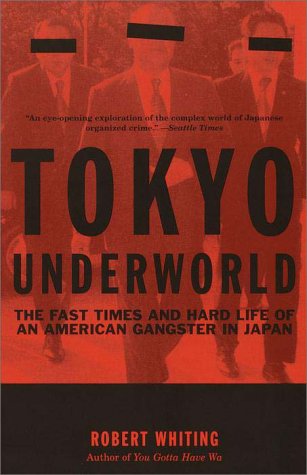
"Tokyo Underworld: Fast times and Hard life of an American Gangster in Japan" by Robert Whiting

I've spent time in a few countries around Asia, but never Japan. In my life I've probably met less than 5 Japanese friends, so studying the language didn't really appeal to me. I studied Mandarin early on and ended up working in China, and I've always been clueless about the combination of classic and quirky in the Land of Rising Sun.

So the first Japan book is all about the Yakuza, rather than Hello Kitty.

Okay, okay, let me be clear, I'm not going to make any generalizations based on a book about crimelords. This is a really fun interesting book, not gruesome or overly violent as you might expect (seedy at times, devoid of morality, perhaps), and just a fun way to get into a totally foreign culture (apart from Sushi, Slam Dunk comics, and the Karate Kid movies).

At the outset of the book, I was pretty excited to learn of Japanese History right after the Second World War. What followed WW2 remains the most amazing Economic turnaround in history.

How long did it take the Mob to recover? It turns out that within 3 days of the American Treaty, the Gangsters were already in action in the Shinjuku, Tokyo and what follows is 300 pages of a crude, crass, corrupt and cold blooded account of those who survived and thrived there.

The book follows an American GI with balls of steel ( tough talkin' Italian New Yorker named Nick Zappetti) who gets in early for the booming Japanese recovery, builds an Italian restaurant Empire and has to fend off would be conquerers.

The whole story is about, brace yourself, bribes. Bribes, bribes and more bribes (in that sense it was very educational!). Everything good that happens in this account is a long chain of payouts under the table, and of course, the anti-Americanism builds throughout the book as the Japanese economy roars back to life (with confidence, the locals grow weary of the Westerners).

We follow a cast of gangsters, grifters, wannabes, and of course, hookers. But while almost everyone in the book is what you might call 'a bad seed' the inner working of business (which goes all the way up to the Japanese political structure and American espionage) are amazing. Much of it was reminiscent of Perkins "Economic Hit Men" but with all the delicacy and stubbornness of Japanese 'Wa' (meant to maintain harmony amongst all things). Ultimately that was the most provocative part of the book: not the hellish violence, or immature cavorting of multimillionaires, but the way Japanese maintained 'face' and their own sense of Japanese integrity, amidst a modernizing and ever more international environment.

The book closes wistfully as we say goodbye to the great Nick Zappetti, a foreigner who's seen the best and the worst Japan has to offer.

Saturday, February 27, 2010

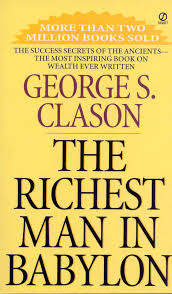
“The Richest Man in Bablyon” by George S. Clason

So I have to preface this review by saying,

a) This book was written in the 1920's.
b) This is a book about personal finance and budgeting.
c) I absolutely love this book and had so much fun reading it, I went back three more times!

Ok, let me explain: I actually bought "The Richest Man in Babylon" in Audiobook form about a year ago. There was a time when I would incorporate Audiobooks into my morning routine (multitasking), but now prefer the selection of Amazon.ca hardcovers and convenient delivery. If you want to pick this up on Audible.com, or download the Audiobook from iTunes, it is an absolute treat. If you get the actual book, it's pure genius and full of charm, but you won't get the great voice acting.

I know. Voice acting? Here's how it works: Clason was a businessman and early 'motivational' guru and would travel around the US distributing pamphlets that would show people how to save money, and build wealth. He didn't just say, 'Do this, do that', though; instead, he created parables set in Ancient Babylon, which would be more engaging and enjoyable to read than the driest subject on Earth...personal finance and budgeting.

So now you can imagine why I had so much fun 'listening' to this book. Set in Ancient Babylon, it tells tales of common men getting together to discuss how they can emulate the local hero, The Richest Man in Babylon (who himself, was a self-made man). The whole thing, as a parable, is one huge metaphor. First you fall in love with the story, then you feverishly jot down notes as you realize just how brilliant this is. The Babylon setting simplifies the whole thing into great archtypes, not overly confusing 401k, IRA, gibberish (which by the way aren't strategies at all, they're just tools).

As the richest man in Babylon relates in this book, even he can't afford to satisfy all his desires, and his stomach cannot fit all the food he might desire to eat each night. Even he is limited by the time on this earth, so he spends his time carefully (budgets his time?). Even he, with all his endless wealth, has a budget. And that budget works for him to make sure each meal is delicious, each hour is spent thoughtfully and enjoyably, and each dollar is spent usefully and intelligently. And here's the kicker: when he eats, he does not mourn that which had no space to eat. He is content with his choices.

Ok. So, so far, absolute gibberish and fluff, right? First we have to get past this idea that you have a money problem. You don't. If you made a million dollars a year, your bad habits would scale and you'd be just like those guys who win the lottery and squander it in 6 months.

The truth is, the fallacy of 'a few more bucks' is so ingrained in our mentalities, that we put off thinking about this stuff until we have more money. When that happens, we spend it. Look, it's pretty simple. In the West, we're just coming out of a huge recession, and yet the Stock Market seems to be ticking along just fine. What does that tell us? That people are still clinging to their credit cards. If you don't have a problem with credit cards/loans, you're the exception, not the rule.

What Clayton does with this book is demonstrate how the very poorest of tramps can start building wealth right now. Today. Is it simple? Sure. Can anyone do it? Yeah. If you have discipline, you can start paying down all your debts and building your own empire.

I'm gonna try not to plagiarize the book by reciting its laws. Go get it. I can, however, give you my own story. After reading this book, I jumped into Excel and starting doing the calculations on the elements it teaches you to focus on:

1) Pay down your debt
2) Contain your monthly expenses
3) Invest in something that will grow

What's hard about this? The initial 'woe is me' complaint that most people have stops them at step one. People also have this annoying fear of money: they'd rather not know how much credit card debt they have. I check every week, to make sure that number is going down.

Lastly I want to say this: if you take one thing away from this book, its that your salary doesn't matter as long as you have discipline; with discipline, you can eliminate your debt and be on the road to prosperity, health and ultimate happiness. Without discipline, you can be Nicholas Cage. Take your pick.

Wednesday, February 24, 2010

"The Ascent of Money: A Financial History of the World" by Niall Ferguson


So go back about 6 months, and I get a call from my parents, back in Canada. Who's going where, how's the garden, what's the next trip they're planning. And they mentioned to me they were watching this really interesting documentary on PBS called 'The Ascent of Money' and it was right up my alley. A couple weeks later, I was in a bookstore in Shanghai and saw it, so I picked it up. While I slogged through The Count of Monte Cristo, this huge book sat on my coffee table for months and months.

Having graduated in Economics, there were bound to be some nuggets in there that caught my eye. I wasn't really stoked for a review of my college textbooks though. Luckily, most of this book is great read because of the story, not the financial meandering (sparse, I promise). The context of what was going on, say, when the first banks started cropping up in Italy is what makes it so fascinating. And what a marvelous story it is: man's quest for riches, dating back to the Babylonians. So allow me to rephrase, this is an Economics book, that is more Archeology and History than x/y graphs and Interest rates.

The Ascent of Money track developments of money, from sheckles to gold pieces, and eventually paper and later online banking in context. A brilliant ride, he shows how , effectively the great wars, won and lost, had a few rich men pulling the strings (or at least betting on the outcome!). The section on the Rothschild family is awesome.

In as pleasant language as humanly possible, he outlines the development of the stock market, what the heck are bonds, why we need to know this stuff , and perhaps more interestingly, the families and empires that were built with the knowledge and understanding of their wallets, and just what incredible power they had.

He outlines the earliest developments of insuarance companies and how similar they are to the modern health care crisis of today (Britain, US, Japan, for example). And you can actually see right where everything broke down, where greed started to be institutionalized.

Obviously I loved it. The whopping Financial history of the world, leading up tot he Enron disaster, Long Term Capital Management, and the Subprime lending crisis (which, everyone hears about, but few actually really understand).

Not surprisingly, he dedicates a full chapter to the resurgence of China. Ferguson coins the symbiotic relationship with America "Chimerica": China lends money to the US, the US uses that money to buy from China (plus interest payments). It's lovely.

What I like the most about this kind of book, is that it does its best to hide the real nitty gritty financial (read: dull) minutiae, but gives you enough so you can follow along in what is really an amazing story.

If this subject is completely foreign to you, it should be a delightful (and enlightening) book. And yeah, I guarantee that after reading it, you will feel like the smartest person in the room. For a few days, anyway. ;)


Follow this author on Twitter@nfergus

Sunday, February 21, 2010

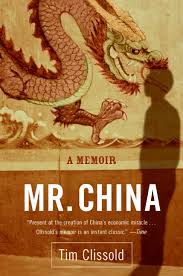
"Mr. China: A Memoir" by Tim Clissold


This one was reccomended to me by a fellow expat colleague back in 2008; finally got around to it, and it's a real gem. Before I go on about how the difference between East and West can cause problems, confusion, misunderstanding, (as well as wonder, fascination and reflection) I'll come right out and say it now:is a cliché. I know. But it is critical to understanding why certain things happen.

Put it this way, were it not for 'misunderstandings' Tim Clissold would be at the helm of a massive empire in China right now, and this book wouldn't exist. Everything they'd dreamed of and planned bumped up against this pervasive, ancient, unshakeable culture. This book is about their attempt to go ahead with their plans and how it all turns out.

This story is about a foreigner, who, like hundreds of thousands who followed him, had a fascination for the exotic, mysterious, richness of Chinese culture, and did everything he could to get 'over there.'

What usually starts off as flirting (traveling around for a week or two, hitting the Great Wall, picking up a book on learning/writing Chinese) turns to full on dating (move to China, get a cool job) and aspirations for a shared future (confidence in culturally and linguistically maneuvering throughout the cities and countysides, with the intent to settle down for good).

Our hero, Tim Clissold, is relentless in his desire to get into China and do something huge. He explains how he got a few lucky breaks, but did what it took to get money ( and lots of it) into China long before anyone on CNN was talking about it. He got in early, which meant, as a trailblazer, he had to be the real liason between East and West. We get firsthand insights on the big bosses in the developing Chinese economy. Just fascinating stuff.

The book turns into a series of Anecdotes about ways in which he dealt with 'the Chinese mind' by way of a handful of clever, tough, and sneaky Factory Managers, as well as navigating the Chinese political structure to not get fleeced in the Middle Kingdom.

I'll admit, the symbolism on the front cover (with a classic Chinese dragon 'biting' a mans head) is a little ominous. "Did he lose his shirt?" "Did he turn to bribes/backdoor deals?" It turns out that neither of these were really true. But his team of investors didn't 'take over' China at all. Not by a long shot.

What you will absolutely adore about this book, besides Tim's astute insight into not only the language and culture "challenges" but his 'case studies' are priceless. Somewhat unbelievable, almost always hilarious, he goes down the list of amazing stories of his mixed bag of Chinese investments. In many cases, the way his Chinese partners attempted to 'get the best of him' was very clever, and the followup is even better.

Come to think of it, the Dragon symbolism is befitting: by the end of it, the dragon doesn't bite his head clean off, it just takes a chunk out of his ego. I think they call that wisdom.

Saturday, February 20, 2010

Think Week

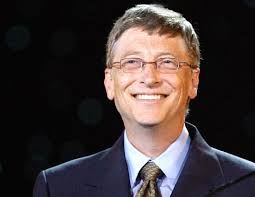
If you haven't heard of Bill Gates' Biannual Think Weeks, this is going to sound pretty crazy: he actually takes off, unplugs, and hides in a cottage twice a year to read books.

I know what you're thinking "Read books? That's so...old fashioned."

Yeah, he's done it for years (well, since he was able to afford a cottage in the hills). It used to be that he would read lots of weird books (really geeky stuff) on Computer Programming, and Financial Instruments, and Business Models, etc. These days, he reads an insane amount of stuff that all comes internally from Microsoft.

Managers at the software giant have 'homework' to hand in to Gates, who spends a week in silence, sipping Orange soda and making notes.

To me, the idea of this guy, worth about 60 billion, trudging up to some remote cottage to 'mark papers' from his employees of 'average intelligence' is just hilarious, and at the same time, inspiring. Even now, he still feels he has a tremendous amount to learn and still strives to be the smartest guy in the room.

So alas, there I was, pondering what to do with my Chinese New Year 'holiday.' I could go to Thailand or Japan, or Sanya, etc. All places which would be expensive/packed for the holiday, and I wouldn't be able to check emails if I was having too much fun, etc. Then it dawned on me... where can I go, where I'll have peace and quiet, and can actually do something productive, ala Gates?

If I stay at the apartment, its way too noisy, and I'll get sidetracked with Internet, Movies, Friends etc.

I actually found a middle ground: I got a hotelroom on the outskirts of Shanghai. A nice one, with internet on the first floor, and room service, out in the far west (near the airport). Minimal disruption, minimal fireworks (99% of the time), and I took a bunch of books.

And you know what? I can probably get away with doing it twice a year. Like I said, I can check emails daily, in the morning, survive off room service, and the amount of time I have devoted to just reading great books (preferably about your line of work, keeping up with the very latest trends in your job, or big picture stuff, like Gates) can be of huge benefit to your company.

One thing I will say, the amount of 'Wow' great ideas I've gotten from this week is astounding. That's how the brain words, you fill it up with 'information' and then it digests it over the course of a few days. It'll rattle around up there, and suddenly BAM, you get the answer to something that was puzzling you (about business strategy, about time management, or about how to get financing on the next big project).

Think about it... you could worse than emulating one of the richest (and smartest) guys alive.

Friday, February 19, 2010

"Synchronicity: An Acausal Connecting Principle" by Carl Jung

What is an amazing coincidence? Is it magic? Is it just impossible luck? Maybe its nothing more than a roll of the dice that the you wake up one day, and you have the flu. As a result you don't go into work, and a few hours later there's a huge snowstorm, and the afternoon rush hour roads are jammed and your colleagues don't get home until 10PM that night. In such a case, you feel blessed to have gotten the flu. But was it just a coincidence, or, was it written, somehow?

One could theorize the weather and your sickness were related. But sometimes, just sometimes, there cannot be any connection whatsoever, and the only two 'explanations' are that you've witnessed a) an amazing coincidence or b) a miracle.


I've wanted to read this book for a number of years; I've been a huge fan of Jung's work since I started reading his amazing insights into personality development (Id, ego, projection, etc). Synchronicity goes beyond those 'theories' of psychology and borders on the paranormal.

Synchronicity, I assumed, was his theory to explain the occurrence of unbelievable 'magical' circumstances, and perhaps, what they can tell us about ourselves. Be warned: although this is only a 120 pager, this was academic piece from a brilliant man, written in 1960. In other words, put the coffee on.

Having read it, I can't believe where Jung went with this idea. Having first introduced the notion of causality and 'connected events' he posits that in such a complex world, it would be easier to start by looking for events that are unique-- they are indeed rare. Connected events are everywhere. He delves into rigorous statistical analysis of card games and dice games, and concludes that ESP may be possible, as well as 'willed outcomes' (Think, The Secret).

This is where Jung gets going. He puts away the calculator for a second and turns to.... Chinese Philosophy?

Having first pondered the possibility of ESP/Psychics/psycho-kinetics, he then discusses several ancient systems of divination, preferring the Chinese (Like the 'Yi Ching') for their holistic approach (again, almost everything is connected). He goes into a very spaced out and esoteric trip consisting of galactic forces (in attempt to prove or disprove Easter and Western Astrological forecasts) and Greek Gods--seriously--knowing that all these things are man's 'creation', the common link is, Archetypes?

Archetypes are an idea of patterns, figures and characters that are common throughout the world's cultures and eras. These seem to be models for possible personalities and relationships which are so universal as to be, perhaps, wired in our DNA to understand (eg. The Hero, the Trickster, the Nurturing Mother--these are ingrained ideas which Jung believes compose our dreams).

This is really an amazing book whereupon, Jung attempts to sit down and prove the power of our minds to either predict the future or create it. I won't spoil the end, because I won't do it justice, obviously, but I'll share an anecdote, which occurred just after I finished reading the book.

It just so happened that during my Think Week, I'd finished a book called 'The Ascent of Money"the day before. Now, there's a part in that book which mentions Mary Poppins: apparently, there's a scene in Mary Poppins where everyone wants to take their money out of the bank at the same time, causing a run on the bank's money. Why do I mention it? Because just before going to sleep that night, and I was watching some TV (keep in mind, this is China, most of the Channels are Chinese talk shows and dramas). I stopped on what looked like a very old movie, with some old-looking white people. It was Mary Poppins.

Why is that weird?

Well first of all its about 50 years old. Secondly, its geared towards a North American audience, making it less liklely to have any appeal whatsoever in China in 2010. The fact that I remembered 'Oh yeah, I was just reading about this yesterday' was amazing. And I'd actually bought that book 'The Ascent of Money' about 6 months prior and never got around to reading it until then. It's amazing that I just so happened to get the book, and then let it sit on my coffee table for half a year before, in the right hotel, on the right week, watching the right channel at the right time, Mary Poppins shows up. And it would have been completely meaningless unless I'd read Ascent of Money they day before, instead of the day after.
You're right, I'm probably just grasping at straws there. Or maybe Synchronicity is just a matter of paying attention to the millions of coincidences and miracles that happen every single day.

Thursday, February 18, 2010

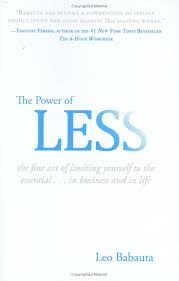
"The Power of Less" by Leo Babauta


I'd already been interested in the a more simplified Zen lifestyle (I've been meditating daily for a couple years now) and picked up this book because the title was so representative of my direction recently: less stress, less hassle, stop messing around and focus on the things and people that are really important to me.

This book is not just a 'guide' for doing less; it seeks to bust what I call the Multitasking Myth: that is, it emphasizes that by doing 14 things at once (MSN, Emails, Music, Twitter, Sending Text messages, Eating...etc) you're actually way less efficient. You're way more stimulated but way less productive.

(Note: there has actually been a bit of talk on 'Multitasking' recently on the web with the recent launch of the Apple iPad, which, unlike a real computer, is generally designed to run just one program at the same time. Techies screeched, "How can you get anything done without Multitasking?"... Ironically, it might be a great built in 'feature')

In this sense, at its core, the message is to 'unitask'. Focus on the task at hand, and finish it. In the same vein as Tim Ferris (http://www.fourhourworkweek.com/blog), Babauta is a big fan of batch processing things. Everything from Email to Errands, Bill Paying etc. And it struck me that its actually a very popular idea: just ask Henry Ford.

We've known the power of specialization of labour for so long, so... why are we so hung up on the idea (rather, the myth) of doing a bunch of different things at once? The truth is, to really hit your productivity groove, you gotta turn off the music, get off Facebook, and focus. The productivitity gains are amazing. I know, I know, the great thing about Multitasking is the flexibility, and the time-saving that comes from driving while you play with the your Blackberry, yada yada yada. Come on, what kind of brilliant writing have you done halfway through a Big Mac? Be honest.

Ok so that was just one element of the book, but I think it exemplifies what we're trying to do here, 'Power of Less' doesn't mean you're doing less, you'll actually do a ton of things, the point is less distraction and less wasted energy on things that, frankly, don't really mean much in the long run.

A big section of the book, Babauta talks about nailing 6 month to multiyear goals by breaking them down and, again, focusing on just a few goals concurrently (you could do just 1, ideally, but there are often time gaps between certain objectives, and we don't want to waste that time idly.)

If you find yourself getting sidetracked easily at work, (it's normal, we all do) definitely check this book out (as well as the aforementioned Tim Ferris classic, 4 hour Work week).

Follow this author on Twitter@zen_habits

Node Zero: "Love is the Killer App" by Tim Sanders


For my first review, I want to go back to the first book that sparked me to get into business. It was early 2000's, and I was working like a dog. At a factory. While I figured out what I was going to do with my life. Everyday after work, I'd get home and eat in front of the TV. Usually around 3 or 4 in the afternoon, there would be some 'Biography' or 'Inside the Actor's Studio' on, and I was always really into those, hearing about brilliant people, and their humble beginnings.

It was around this time that I saw the story of Bill Gates and how Richard Branson started his empire when he was 16, etc. I was buzzing off these 'interview' shows, and there was something about them that really turned me on, I wasn't sure what it was, but each one had a nugget of genius, and I felt that if I could just keep getting the odd nugget of genius, maybe I could find what I wanted to do with my own life.

Flipping the channels one such afternoon, I stopped on a local access show because there was this wild looking hipster guy, with purple tinted shades passionately talking up a new way of doing business. I listened with rapt attention, as this guy, Tim Sanders, tore apart every negative stereotype about the big bad world of business.

"These sharks don't last"..."No one wants to be that cheesy guy at the Office"..."I love my Company"..."The people I work with are rockstars!"

Before I even knew what company he worked for (Yahoo!) and what his 'job title' was (Chief Solutions Officer) I knew I had a lot to learn from this guy. He was living the existence I'd always dreamed of, basically he was a Businessman with a Conscience. No, scratch that. He was a Passionate Businessman! And he wasn't just scraping by, he had landed a huge role at a huge company that had their pick of pretty much anyone for that job. In other words, his 'passion' wasn't a fluke, his conscience, his authenticity was a core element of how he did his job! It was the thing that set him apart from everyone else! At the time, it was a real revelation to me that being anything other than a slimy salesman could be an... advantage in the workplace.

He'd written all his ideas down in a new book, and within days I was delving into "Love is the Killer App: How to Win Business and Influence Friends." Tim breaks down his holy trinity of Bizlove: Knowledge, Networks and Compassion. This was so huge to me then, and now, looking back, it's still a rarity to find people who act the way this guy lives.

The idea goes something like this: you can actually have really close relationships with great people in the office, it doesn't have to be cold, and it doesn't have to be cheesy and fake, but you have to have to know you're stuff first. And for that, you have to hit the books, and you have to become a social animal, networking the right way.

In order, reading great books, applying their knowledge, sharing it freely with your growing network, and then, when you have demonstrated to people that you know your stuff, then you can start building sincere relationships with people. If you do that, you'll almost never lose a sale, you'll almost never be undercut by a competitor, because it won't be about dollars and cents, it'll be a sincere partnership, in a sea of Machiavellis.

If you don't know anything, and start making promises to the customer (eg. all your prospects) and then let them down, you are the cheesy guy. You're the shark.

At the end of this great book is a killer Reading list to get the newly indoctrinated on their way, not only Business books, but books on Tech, books on Out of the box thinking, and books on ...Love.

I couldn't recommend this book more highly, and if it isn't already obvious, Tim Sanders' ideas are what led me to eventually studying Business in school, and even doing this very blog. Tim Sanders, among other things, is the anti-Cynic, and I believe, that should be enough to get you to pick up his book. Once you get a few pages in, you'll be hooked.

Follow this author on Twitter@sanderssays

Saturday, October 17, 2009

Wednesday, October 18, 2006

Doing Mushrooms and the Art of Feeling Important

Phew. That long of a break eh?

So first the mushrooms bit. No I didn't do mushrooms last week. No I didn't drop acid. And I didn't discover the meaning of life.

Now that we got that out of the way, I have been doing the grad school thing. Is it hard? A litte. We are required to have 7 or 8 'projects' ongoing continuously. My strategy has been, I should be chipping away at all of these every night, so I never have to cram or force something.

Interestingly, there is much less emphasis on tests (which we have) and midterms (which we also have) but projects. We are always doing presentations and projects. I've said this before and I'll say it again: get good at talking and thinking on your feet. Whether it means joinging the debating team or just some minimal involvement in student politics, whatever you do, it will benefit you greatly in grad school. A lot of students who don't have that are really stressing out and wasting energy at the last minute and I'm just ..... chilling. What's going through my mind? I know things will be okay. I also know that the worst thing I could do is freak out and ruin what I've built up so far.

At any rate... after all this school you do.. and all these tests.. and all these GPA points youv'e fretted over, what do they tell you? "It's not about being smart. It's about networking." So on top of the school stuff, they come right out and say, "Oh yeah, and...make sure you're funny, interesting and charming, or you won't go anywhere.."

Not that I'm scared, but it's kind of funny.

Doing mushrooms. I do want to mention something about that. I've been to all these networking events, sometimes they're really far away, in some town I've never been. Have you ever been somewhere new and felt... a strange sense of peace? Last week I went to a former prof's house to discuss a project about Future Studies. Her house was way out in Anmore, which is basically a half an hour north of SFU, which is... out there. Being somewhere that seems so disconnected from your 'routine' life seems to give you perspective, which is exactly what mushrooms do.

Anyway, I hope that, if Anmore gives me the chills, Beijing will give me convulsions. ;)

More later, this is starting to get fun. I definitely feel great about this program :)

Monday, September 04, 2006

Food is good. China playing nice is even better.

One of the keys to development in the US, back in the 1900s was greed. Is that it? Greed? The westward expansion of the US acted like a saftey valve; if things got too populated, or too busy, or too conflicted in the ports, people could expand westward. The prospect of land, and natural resources (ahem) and gold made the Western Founders the risk-takers and entrepreneurs.

In China, it's not that easy. They have this big desert to contend with. Actually there has been serious neglect of the Chinese farmers, which, sounds inconceivable considering the importance of food, with such a massive population.

The density of population here in Canada makes the Chinese situation a little hard to imagine. 'Why would people live in the desert?' Here in Canada we tend to revolve around major metropolitan cities. The trend is clear. In China, you have masses of disconnected, uneducated people in the rural countryside. Finally the government's doing something about it. Admittedly, this is a great thing, and we'll watch how things shift over the coming years. Here in Canada, we must not take what we have for granted: education is paid by tax dollars, health care paid by tax dollars, and even the bare minumum needs are met by tax dollars (i'm referring to different iterations of the welfare system). The Chinese should be so lucky.

China has focused on developing its industries and cities in the past 20-plus years. Sluggish rural development provides a stark contrast to booming urban economy.

China set the goal of building new countryside last year, hoping to achieve balanced development in the country.


Todays announcement is not really about education, but incentive. The growth and expansion of the US in the gold rush was about greed and incentive--something sorely lacking under a totalitarian Communist government.

You can read more here about the land rights issue, which comes down to incentives. In economics we talk about internalizing the benefits and costs. The motivation comes from an internalized benefit, which in this case, is profit sharing. Good stuff.

In other news, 40% of Chinese don't speak Mandarin. Hmmm.. Did I read that correctly? I guess that speaks to the importance of Cantonese and other dialects; we've all heard (or experienced) the difficulty of learning to read and write Chinese. Remember that 40% number when someone questions China's 'developing country' status. It's not just about money, but GDP per Capita, Health Standards and Literacy Rates. Those three things are what make up the Human Development Index, and are richly interlinked (ie, increases in one assist the other two).

Wednesday, August 30, 2006

School... More School? This is too fun.

No way. Done with memorizing charts and stats and lists..

I'm starting to LOVE where I've decided to spend the next 2 years.

The McRae program is an International Business training program ... Involving extensive networking, language and cultural skills---on top of the all the.. you know.. business stuff (marketing, finance, economics, politics, current events).

This week has been INSANE.... The orientation has been incredibly fun, I met my classmates (about 30 kids ranging from 22-34 yrs old) from all over the WORLD: Brazil, France, USA, China, South America and on and on...)

So far it's been shmoozing, as well as tons of team-building games: incredibly fun! From minute one we were goofing around and getting to know each other--I can tell it's going to be an incredibly tight group :) !

Today was a BLAST. The itinerary said "Personality Testing".... Some people may not buy into any of this stuff, but the results were pretty startling. They put us through a mini-test to find what kind of personality we were (Planners, Analysts, Group Work, Risk Takers) and had us talk about how we think and 'offended' we are by the other groups. ;)... Sounds cheesy, but really, the people who were grouped together had INCREDIBLE rapport considering we only met 2 days ago... we all thought the same way, quite eery. Me? An analyst. Sometimes I take forever to make a decision, and I'm a bit of a perfectionist (ugh, that's sometimes a pain in the ass) but I'm very curious and love to find out about new parts of the world, and new things etc.

Anyway, the other part of the day was taken up by Language Testing and Networking Workshops.

I love learning Chinese so much. It's such a simple, fun language to learn, and despite the fact that I hear it like everyday, I hardly ever speak it. It was cool to 'be forced' to speak Chinese today and actually be able to (ahem) converse with the Mandarin Prof. The other guys in the group are pretty amazing.. a few of them had lived in Taiwan for 4 years so... it's really inspirational to see their level. And yes, they all know about ChinesePod.

On top of all this school stuff which is wild and a little unreal... I have a wedding (gulp, not mine... my brother Ian) to 'worry' about in the next couple weeks. So much drama. I am going to stop working so much to do all the stuff i WANT to do (stag party...stag party...stag party).

Oh. And I'm going to take up golf too. Hawt.

Friday, August 18, 2006

China and N. Korea

Alright, this is something that came up some time last week. I've been busy, but this is actually very big news.

All this stuff we keep hearing about North Korea and China is scary. They share a common thread with Communism. Does that mean that no matter what, China will still back North Korea? That has always been the fear.


Vice Premier Hui Liangyu visited Pyongyang to celebrate a 45-year-old friendship pact with North Korea, and to coax the isolated totalitarian state back to disarmament talks after its July 5 barrage of missile tests alarmed Western capitals.


But China's failure to sway North Korea and its weekend vote for the U.N. resolution condemning the missile tests exposed frustrations behind China's public vows of friendship, and raised the price Chinese President Hu Jintao may pay as he seeks to somehow both comfort and cajole Pyongyang.


In January, North Korea leader Kim Jong-Il made a nine-day visit to China. Hu hosted Kim several times, proudly showing him oversized vegetables at an agriculture institute.


Speaking of cucumbers...


China believes an endangered and resentful fortress state on its doorstep could threaten its security, and waves of refugees from a North Korean collapse could destabilize its northeast.

While few Beijing analysts doubt China must engage its struggling Stalinist neighbor, some are now wondering whether Hu's embrace of Kim may have emboldened Pyongyang.

"It's been very easy to create misunderstandings, because it created the impression that China cannot abandon them," said Shi Yinhong, an international security expert at the People's University of China in Beijing.

"It's been very easy to create misunderstandings, because it created the impression that China cannot abandon them," said Shi Yinhong, an international security expert at the People's University of China in Beijing.


Some officials in Washington had hoped the crisis would drive Beijing to coerce Pyongyang, but Chinese analysts say it has in fact illustrated the diminished leverage China has since bowing to Washington over its financial sanctions on North Korea.

Pyongyang is bitter at Beijing's acceptance of U.S. sanctions on a bank in Macau -- the gambling enclave that is Chinese territory -- after the bank was accused of acting as a conduit for North Korea's criminal earnings, said Shi.

"That's cut Chinese leverage over North Korea," Shi said.


Um, so China getting less crazy, North Korea getting more crazy? D'oh..


The deepening impasse over North Korea may ripple across China's broader international standing.


China's has used its hosting of six-party talks aimed at ending North Korea's nuclear ambitions to burnish its image as a "mature and responsible global actor", said Andrew Scobell, a specialist on China and North Korea at the U.S. Army War College.

South Korea, the United States, Japan and Russia also take part in those discussions, which have stalled since late last year over North Korean objections to the financial sanctions.

"If the six-party talks collapse that would be a major setback," said Scobell, who stressed he was offering his personal views. "The talks have given China a chance to project an image as a global statesman."

China will now be weighing what combination of promises and pressure may induce North Korea to desist from further missile launches and return to talks, said analysts.

South Korea has already announced a suspension of aid, making China's economic lifeline to North Korea all the more crucial.

Trade between North Korea and China reached US$1.58 billion in 2005, an increase of 14 percent on the previous year, according to South Korea's Trade-Investment Promotion Agency.

Beijing may consider a "temporary limited, unpublicized" squeeze on the flow of trade, aid and oil to pressure Pyongyang, said Shi.

But the Chinese Communist leadership's entrenched interest in North Korea's survival mean it will probably reach for rewards, not punishments, to lure Pyongyang back to talks, said analysts.

"North Korea never does anything without demanding something in return," said Scobell. "The Chinese are going to have to pony up something significant to get them back to the table."


Saturday, August 12, 2006

Next Season of 24... The Chinese are back

Alright, so my favorite show on TV (now that the Apprentice is kinda over, and the Sopranos last season was limp) is coming back for season 6, starting in late August.

As we know Jack got abducted by the Chinese at the end of the last season and is on a torture chamber on a Chinese ship in the middle of the Pacific Ocean. Can't wait to see more of Jack. Here's a quote from Sutherland himself,

Kiefer Sutherland revealed Sunday in an interview with a British newspaper that expect the sixth season of "24" to be more an inward journey.

"We've had five years of him saving a large thing. This one's much more about him saving his own ass. He'll go from being the one who hunts people down to the one who's being hunted, so that in itself turns the show around" says Sutherland.


The last season was pretty amazing, partly because of the 'life imitating art' spookiness of the US middle east crisis. Um, thanks Bush?...


Okay, enough of that, since we're on a China+Pop Culture bent, how about the NBA? David Stern recently said he was excited that 1 in 4 NBA players are from countries outside of the US, and China is actually their Number 1 priority these days. Last time I checked 1.2 billion is indeed a big number, but realistically it's still a 'growth' market. The good news is that China is getting special treatment--they'll be getting their NBA games again:

Regular season NBA games could take place in China as early as next year, league commissioner David Stern said on Sunday.

The last time the NBA came to China was in October 2004 when the Houston Rockets, led by local hero Yao Ming, played pre-season games against the Sacramento Kings in Shanghai and Beijing.

"We didn't have the China game in the following year in 2005 because we were having a collective bargain then," Stern told state news agency Xinhua in Guangzhou.

"We don't have it this year because of the preparation of the world championship.

"But we are planning to play some games next year here. It could be pre-season, or even regular season."


David Stern has been doing some wacky things over the years, even muttering something about an International Basketball League, so anything that brings the NBA and China closer together is a good thing.

Okay, so we know all the best NBA players (sorry Kobe) come from dire circumstances--is China the new ghetto hotspot for NBA talent?

Why not ask this guy?

Apologies for the cheesy music.

Sunday, August 06, 2006

Sunday Morning Muse

This is what I was thinking about when I woke up this morning. Groggy from a noisy, blurry Saturday night.. I can scarcely get a grip on what I'm thinking about, so I'm writing it down.

Is there ANYTHING about you that you'd like to change? You're too skinny/fat/shy/obnoxious.. maybe you've been trying to start something, learn a hobby/skill, become a better friend or a better boyfriend/girlfriend.

The point is, if there's ANYTHING about yourself you've written off as a personality flaw, etc, you can change it. You can be ANYONE you want.

And if you think about it, it's great that we all have flaws. We are all endowed with flaws at birth, character flaws or physical limitations, this is a CHALLENGE, and thank goodness we all have challenges or life would be BORING.

Imagine a movie with no conflict. Yeah. That boring.

So what do most people do?

They look at successful people and copy the EFFECTS OF SUCCESS.

Interesting, they see someone like a famous actor or high paid executive and try to be him by copying the things AROUND him. It's a big lie, like, "If I can dress like him and look like him and drive the same car, and get a hot girlfriend, EVERYONE WILL CONFUSE THE TWO OF US"

The problem is that YOU'LL know the difference. And you'll be empty. And the other guy will still be excited to get up every morning and do what he does, be it acting, his business, or his political agenda or whatever.

But there IS value in imitation. So now I'm a hypocrite. ;)

In my mind, it's pretty great that "successful" people are highly visible. It's like a public good. As soon as a celebrity hits the 'big time' they are in books, magazines, and on TV. You have the internet at your fingertips right now and can search for ANYONE in the world who is 'famous.'

From now on, these people are going to be our models for a successful 'career.' We're going to imitate them like crazy. For other things in your life, you can model as well and INTEGRATE certain behaviour into your life. So if it isnt the stuff AROUND them, what are these people doing that you're not.

Making different decisions. Sorry if that sounds like a non-answer, but that's it. Getting the clothes or the car will NOT work, that's the EASY PART. You have to start making DECISIONS like a successful man/woman/actor/journalist.

What do most people do? They try to come up with a logical reason for every move they make, analysing their problem to death and trying to come with with the 'solution.' They call it 'soul searching.'

This brings me to the next step.

Stop thinking. Stop Soul Searching. Stop waiting for a day when being healthy/charming/diligent will make sense. It will make sense after you've done it. That's why you have to force yourself to do it.

There's probably ONE part of your mind that isn't doing you any good. The cliché would be a doorman at a hotel. The friendliest guy in the world. Very nice and talkative, good looking guy, but just can't figure out how to take his doorman job and go UP the ladder. There is no ladder. How can he expand his circle of influence and see career growth?

Just like you, that doorman has what I like to call a 'mad scientist' in his head. We all have it. A mad scientist in our head in charge of SOME aspect of our lives. He's very good at coming up with graphs, tables, logical formulae. But he's C-R-A-Z-Y ! You should not listen to a word he says. He's not gonna build a time machine, crack cold fusion or discover the elixir to eternal life. And he's NOT going to help you lose weight/get a raise/meet new friends. He's not. He's crazy. He hasn't been out of the house in YEARS. You shouldn't listen to a damn thing he says.

So combining these two ideas we have a model for HUGE success:


1.Successful people tend to be highly visible. This is a library for success. Pick anyone on earth, find their biographies. You can model them by copying their ACTIONS. Don't bother trying to think like them yet, you're not there yet.

2.Block out the logical part of your brain that has been trying to solve this problem for 10 years. Haven't you given the mad scientist enough time to prove himself/herself?? The mad scientist is crazy, and should be ignored. It'll be tough at first, but over time, you won't hear him/her.


Lastly, to vanquish any further doubts (ahem, mad scientist?)remember that NONE of the important things are UNSOLVABLE. The real challenge in your life is THIS. Whatever it is, you're probably confronted with it on a daily basis. You've probably thought it's 'not fair' that you've got this one thing that no one else has to deal with.

Be thankful that you have a challenge, your movie has a conflict. You should be ecstatic! But when you solve this problem, you will run into another problem, and after that there will be another problem.

THIS IS A GOOD THING!

The point is not to have 'zero problems' but to have better problems (credit Tony Robbins)...

Imagine the day when you're getting home from work, your loving family is at a restaurant and they call you to tell where they are. As you're talking on the phone in the car, you're a little distracted and hit the car in front of you. Nothing serious, but you are going to have to pay it out. These are the moments when you're going to be angry IN THE MOMENT and think to yourself "Why me!? Why does this stuff happen to me?"

Stop.

In moments like this, the mind blocks out the past, the future and childishly and selfishly focuses on the moment. You're on the way to share a dinner with your family that loves you. That's a pretty nice problem to have. The hundred bucks you're paying out for the car would NOT have made you happier, so you really have nothing to be mad about. Allow yourself to be happy.

You will never be free of problems as you grow more and more, but THATS A GOOD THING. Or else you would have a boring movie.

;)

Long post. Phew.